
Kharidar First Paper Syllabus: General Knowledge and BOST Units
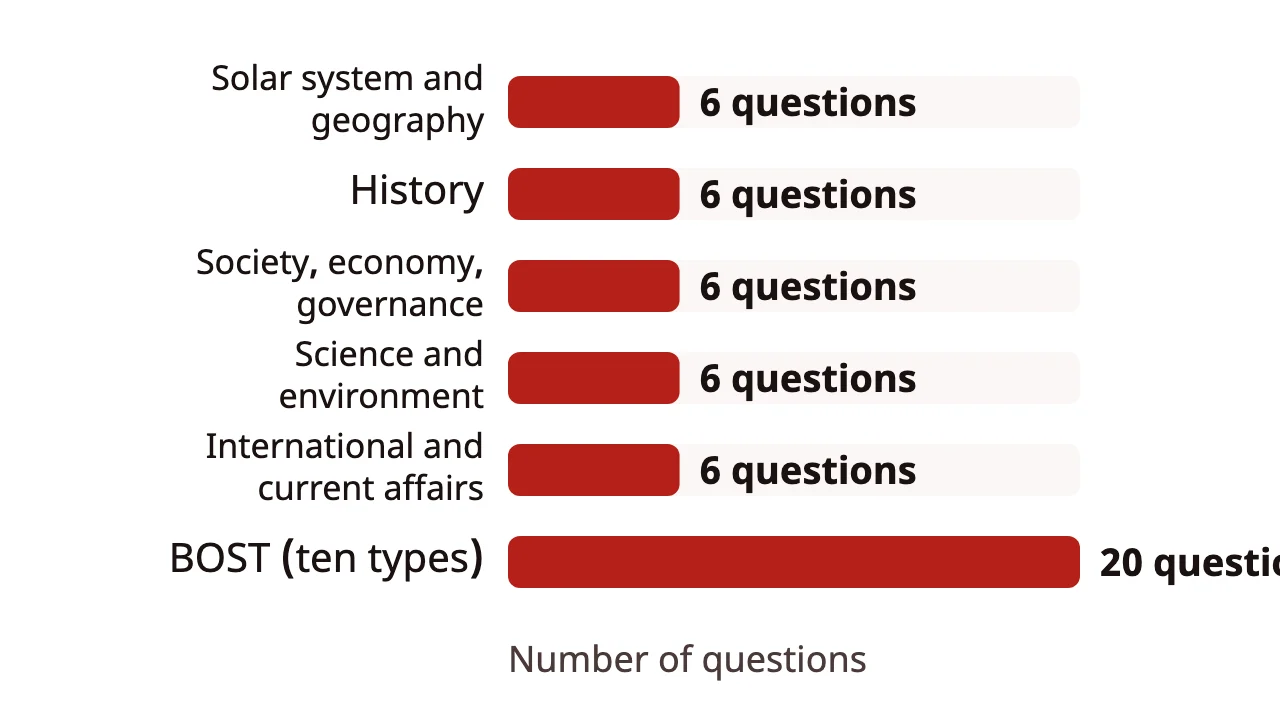
The Kharidar Paper I syllabus from the PSC: Section A general knowledge in five units of six questions each, and Section B, the Basic Office Skills Test with ten types of two questions each. 50 MCQs, 100 marks, 45 minutes, pass mark 45.
The Kharidar (खरिदार) first paper is called "General Knowledge and Basic Office Skills Test": 50 multiple-choice questions, 2 marks each, 45 minutes, pass mark 45. This page lists every unit of the PSC's Kharidar first paper syllabus, taken from the official PDF.
Kharidar first paper syllabus: Section A, general knowledge (60 marks, 30 questions)
1. The solar system and geography (6 questions, 12 marks)
- General facts about the solar system and the Earth.
- World geography: continents, oceans, poles, latitude, longitude, time, distance, mountain ranges, earthquakes, volcanoes, rivers, glaciers, lakes and climate.
- Nepal's geography: location, landforms and natural resources (water, wildlife, plants, soil, minerals and hills).
2. History (6 questions, 12 marks)
- World history: the Industrial Revolution, the French Revolution, the American War of Independence, the Russian (October) Revolution, the First and Second World Wars and the Indian independence movement: events, causes and results.
- History of Nepal: social, cultural, economic and political conditions in the Kirat, Lichchhavi and medieval periods; modern history from unification to the present.
3. Nepal's social and economic conditions and governance (6 questions, 12 marks)
- Society, traditions, values, religion, castes and ethnic groups, languages, culture, art, literature, music and cultural heritage.
- Economic indicators: economic growth, gross domestic product, per capita income, remittance, foreign investment and foreign aid.
- The economy: agriculture, industry, trade, tourism, transport, communication and development plans.
- Governance and government: the constitution, the federal system and the political system.
4. Science and technology, public health and the environment (6 questions, 12 marks)
- Major scientific inventions and recent developments that affect human life directly.
- Public health, disease, food and nutrition.
- Environment, biodiversity, sustainable development, climate change, environmental management, pollution, population, urbanisation and migration.
5. International relations and current affairs (6 questions, 12 marks)
- The United Nations and regional organisations (SAARC, ASEAN, the European Union).
- Current events of national and international importance, notable personalities and thinkers.
Level I and Level II questions
The syllabus asks for about 60 percent Level I questions in general knowledge, which are simple four-option MCQs, and about 40 percent Level II questions, such as matching, filling in blanks, cause and effect, or putting events in order. Out of 30 GK questions that is roughly 18 and 12. Level II questions take longer to read, so practise them on purpose instead of only simple recall questions.
Section B: the Basic Office Skills Test, BOST (40 marks, 20 questions)
Two questions come from each of these ten types:
- Verification: check data, numbers or words and find errors, similarities or differences.
- Completion: complete a verbal, numerical or picture series, pattern or matrix.
- Classification: pick the odd one out.
- Analogy: recognise the relationship in a given pair.
- Filing aptitude: put items in alphabetical, numerical or date order.
- Following instructions: carry out written instructions exactly.
- Numerical reasoning: simple arithmetic operations.
- Coding and matching.
- Analytical reasoning.
- Direction and distance.
Study by question weight
All five GK units give the same six questions, so do not spend too long on any one of them. The constitution and federalism questions in unit 3 also help in the second paper. The current affairs of unit 5 change every year, so read the main events of the 6 to 12 months before the exam.
BOST gives 20 questions worth 40 marks, more than any GK unit. BOST questions do not get faster by memorising; they get faster with repeated practice. Aim to answer each type in 40 to 50 seconds on average, because you have only 45 minutes for 50 questions.
How to study this paper
Every BOST type is explained with examples in our BOST guide, and a day-by-day plan is in the 30-day Kharidar first paper plan. For unit practice try the Kharidar sample questions (in Nepali). The full syllabus is on the Kharidar syllabus page and the format on the Kharidar exam pattern page.
Frequently asked questions
How many questions come from each GK unit in the Kharidar first paper?
Six from each of the five units (12 marks each): the solar system and geography, history, social and economic conditions and governance, science, health and environment, and international relations with current affairs.
What are Level I and Level II questions?
The syllabus asks for about 60 percent Level I questions (simple four-option MCQs) and 40 percent Level II questions (matching, fill in the blanks, cause and effect and similar) in general knowledge, that is 18 and 12.
How hard is BOST?
According to the syllabus, BOST is not based on any particular subject. It is set at a level a class 10 graduate can answer and tests analysis more than memory.
Sources
- Kharidar or equivalent syllabus: Stage I (PDF, Nepali), Public Service Commission (2024-07-25)
Courses for this topic
Kharidar General Knowledge (GK): Paper I
The 60-mark GK part of the Kharidar first paper: all five units with video, notes and MCQ practice.
Kharidar Basic Office Skills Test (BOST): Paper I
The 40-mark BOST: tricks for all ten question types and timed drills.
Kharidar First Paper Pack: Pass the Screening
GK, BOST, mock tests and weekly current affairs for the Kharidar screening, in one pack.

Study in the Dipa App
Buy courses, join Live Classes and practise every day in the app. Payment works inside the app with eSewa.

Author
Dipa Academy editorial team
Dipa Academy's editorial team writes Lok Sewa guides from the Public Service Commission's official syllabus, notices and results, and cites every source.
Read next
Nasu Third Paper: a Different Paper per Service Group
21 November 2026 (मंसिर ५, २०८३)Nasu Second Paper: Contemporary Studies and Public Service
21 November 2026 (मंसिर ५, २०८३)Kharidar Third Paper: the Acts, Accounts and Law to Study
21 November 2026 (मंसिर ५, २०८३)