Kharidar Syllabus 2083: All Three Papers and the Final Stage
The official Kharidar syllabus of the Public Service Commission, in force since the FY 2081/82 advertisements: Paper I (general knowledge and BOST), Paper II (office management), Paper III (Job Knowledge) and the final stage, with marks per section and links to the PDFs.
The Public Service Commission (PSC) has published the syllabus for Kharidar (खरिदार) or equivalent posts (non-gazetted second class), in force from the FY 2081/82 advertisements. It still applies to the Kharidar syllabus 2083 exams. This page shows the structure of all three papers and the final stage; each paper has its own page with the unit-by-unit detail.
Kharidar syllabus 2083: the structure
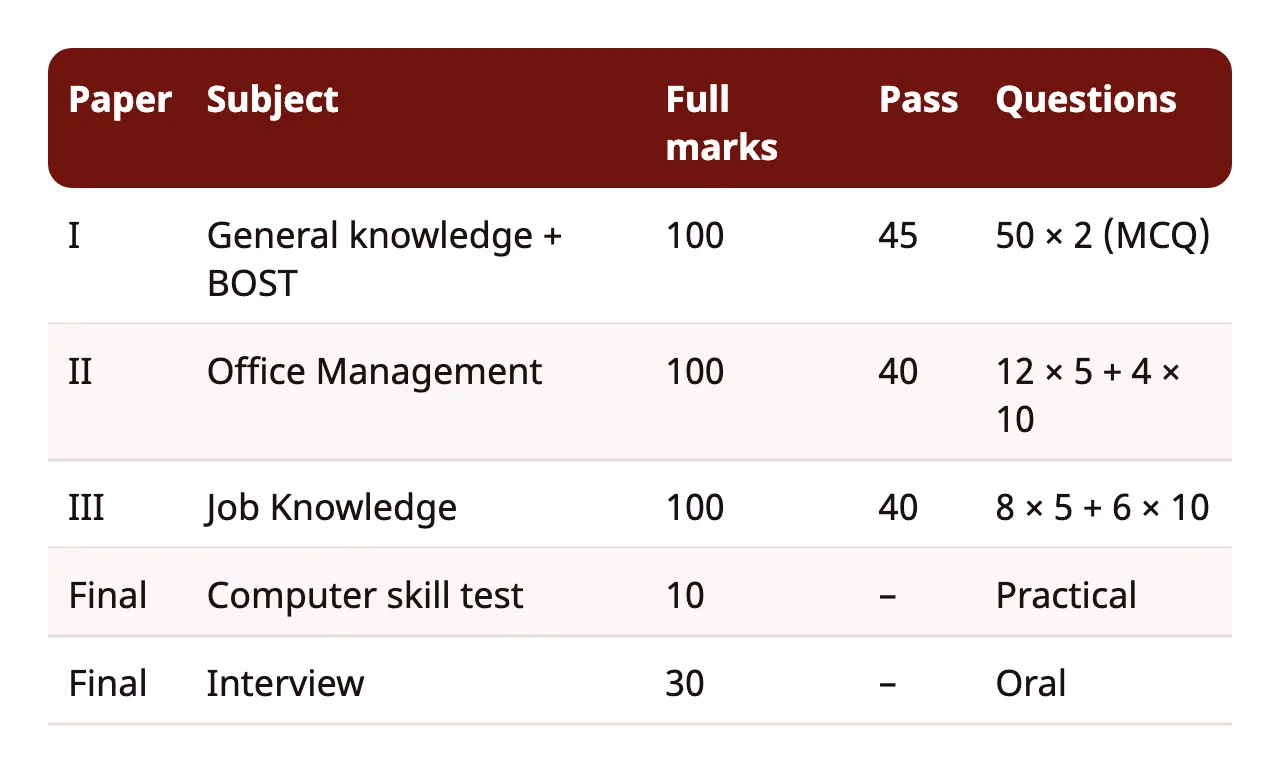
The syllabus follows the joint and integrated exam system and is the same for every group of the Judicial, Foreign Affairs, Administration, Audit and Parliament services. The exam has two parts: the written exams (Stage I with 100 marks and Stage II with 200 marks) and the final stage (40 marks).
Paper I: general knowledge and the Basic Office Skills Test
Section A, general knowledge, has 30 questions worth 60 marks across five units: the solar system and geography; history; Nepal's society, economy and governance; science, public health and the environment; and international relations with current affairs. Each unit gives 6 questions. Section B, the Basic Office Skills Test (BOST), has 20 questions worth 40 marks, two from each of ten test types. In detail: Kharidar first paper syllabus.
Paper II: Office Management
Section A, office management, 40 marks; Section B, the constitution and civic awareness, 30 marks; Section C, general mathematics, 30 marks. In detail: Kharidar second paper syllabus.
Paper III: Job Knowledge (पदीय ज्ञान)
Section A, public service management, 35 marks; Section B, accounts, public procurement, inventory and audit, 35 marks; Section C, law and justice, 30 marks. In detail: Kharidar third paper syllabus.
The final stage
The computer skill test (10 marks, 15 minutes): Devanagari typing 2.5 marks, English typing 2.5 marks, and Windows and word-processing tasks 5 marks. The interview is worth 30 marks. The typing score table is on the Kharidar exam pattern page.
Important rules in the syllabus
- Stage I is a screening exam only, with a pass mark of 45. Its marks are not added to the main exam.
- In multiple-choice questions, 20 percent of the marks are deducted for a wrong answer; nothing is deducted for a blank.
- Calculators are not allowed in the multiple-choice exam.
- In subjective papers, the answers to each section go in a separate answer book.
- Laws and policies in force three months before the exam date are treated as part of the syllabus.
- The final result is worked out from the total of Stage II and the final stage.
An order of study that follows the syllabus
- First month: the five GK units of Paper I and the ten BOST types. Without passing Stage I you cannot reach the other stages.
- Second month: the office procedures of Paper II (letters, notes, records) and general maths; the named chapters of the acts in Paper III.
- Third month: the constitution, public procurement, accounts and law; practice writing 5-mark and 10-mark answers.
- Alongside: ten minutes of Nepali typing every day and current affairs once a week.
For a day-by-day plan for the first paper, see our 30-day Kharidar first paper plan. Our courses follow the same structure: one course for each part of the first paper, one for each written paper, and the final stage, all listed on Kharidar preparation.
How the papers fit together
The general knowledge of Paper I, the constitution in Paper II and the public service topics of Paper III overlap, so time spent on one helps the others. The Nayab Subba syllabus shares much of the same general knowledge, which is why many candidates sit both exams.
Where to find the official PDFs
The Commission publishes the syllabus as two PDF files in Nepali: Stage I and the computer test and Stage II. If anything on this page differs from those files, the PDFs are final.
Frequently asked questions
Since when has the current Kharidar syllabus applied?
The syllabus published by the Public Service Commission applies from the FY 2081/82 advertisements onwards. If it is revised, the Commission posts a notice on its website.
Is the Kharidar syllabus the same for every service group?
Yes. Papers I, II and III are common and compulsory for all groups of the Judicial, Foreign Affairs, Administration, Audit and Parliament services.
Which version of the laws should I study?
The syllabus says to study the laws, acts, rules and policies in force (with amendments) three months before the exam date.
Sources
- Kharidar or equivalent syllabus: Stage I and computer skill test (PDF, Nepali), Public Service Commission (2024-07-25)
- Kharidar or equivalent syllabus: Stage II (PDF, Nepali), Public Service Commission (2024-07-25)
Courses for this topic
Kharidar Complete Preparation Pack: Screening to Interview
One payment for the whole journey: first paper, second and third papers, computer test and interview.
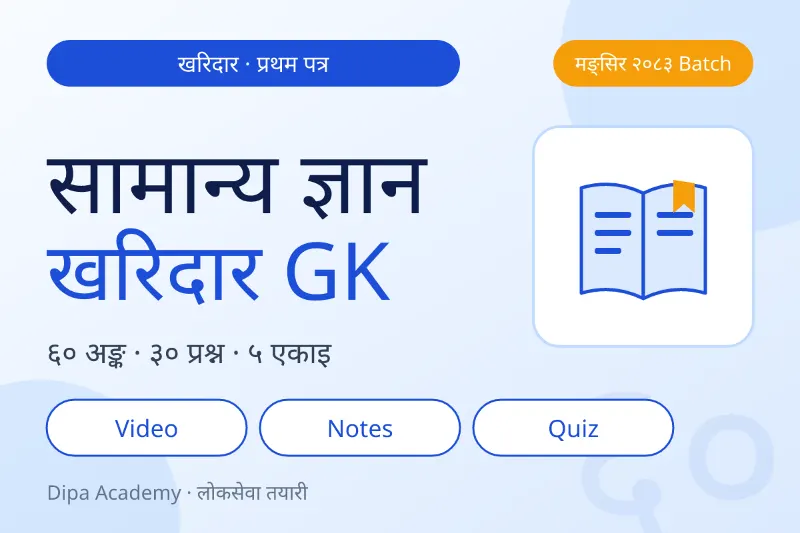
Kharidar General Knowledge (GK): Paper I
The 60-mark GK part of the Kharidar first paper: all five units with video, notes and MCQ practice.
Kharidar Basic Office Skills Test (BOST): Paper I
The 40-mark BOST: tricks for all ten question types and timed drills.

Study in the Dipa App
Buy courses, join Live Classes and practise every day in the app. Payment works inside the app with eSewa.

Author
Dipa Academy editorial team
Dipa Academy's editorial team writes Lok Sewa guides from the Public Service Commission's official syllabus, notices and results, and cites every source.
Read next
Nasu Third Paper: a Different Paper per Service Group
21 November 2026 (मंसिर ५, २०८३)Nasu Second Paper: Contemporary Studies and Public Service
21 November 2026 (मंसिर ५, २०८३)Kharidar Third Paper: the Acts, Accounts and Law to Study
21 November 2026 (मंसिर ५, २०८३)