
Kharidar Third Paper: the Acts, Accounts and Law to Study
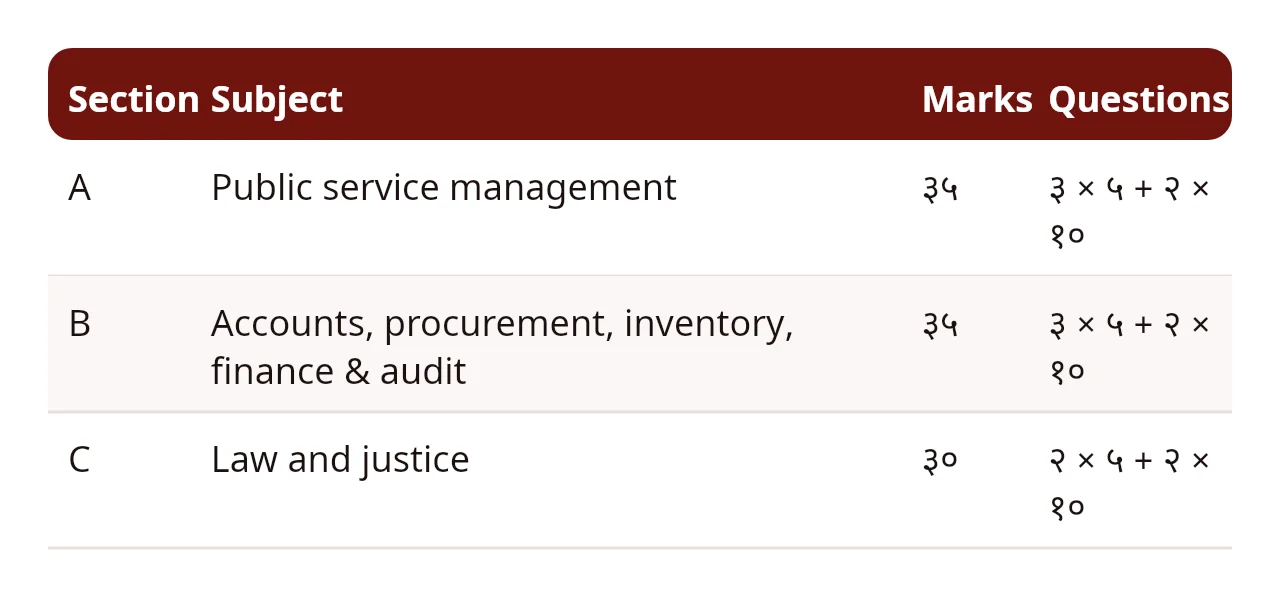
The Kharidar third paper tests job knowledge across 100 marks: public service management 35, accounts, procurement and finance 35, law and justice 30. The listed acts and their chapters, the reading order and the answer style.
The kharidar third paper — "job knowledge" — decides ranks because it is the paper candidates prepare least systematically. It is a 100-mark written exam of fourteen questions in two and a half hours, pass mark 40, built almost entirely from named chapters of named acts.
Section A: public service management (35 marks)
Civil service fundamentals: the civil servant's conduct and duties, public service delivery, the citizen charter, grievance handling and good governance. The Good Governance Act's listed chapters and the Civil Service Act's conduct provisions anchor the answers; every response improves when it cites the act and chapter by name.
Section B: accounts, procurement, inventory, finance and audit (35 marks)
The technical core: the government accounting system and its forms, the treasury single account idea, budget release and expenditure, public procurement (methods and thresholds from the Public Procurement Act's listed chapters), inventory (jinsi) management, revenue and deposit basics, and internal versus final audit. Questions are factual: which form, which method, whose responsibility, within how many days.
Section C: law and justice (30 marks)
The listed chapters of the Constitution's justice-related parts, the Muluki Civil and Criminal Codes' introductory chapters, the Right to Information Act (chapters 1, 2 and 4) and court structure. As in section A, the chapter citation is the mark-winner.
The reading order that works
- Start with section B — it is the most factual and the easiest to secure with tables (form numbers, thresholds, timelines).
- Then section A — fewer acts, high overlap with the second paper's civic unit.
- Then section C — read last so the chapter lists stay fresh.
Build one table per act: chapter → what it governs → two or three quotable provisions. The syllabus names the chapters; read exactly those, three times, rather than whole acts once.
Answers that cite law
The 10-mark format: one-line definition → the governing act and chapter → the provisions as numbered points → one practical sentence on how it works in an office. "According to chapter 4 of the Good Governance Act..." is worth more than a paragraph of general prose.
Study plan
Two written sessions a week (one 10-mark answer each, handwritten and timed), one act-table revision session, and a full paper every second weekend, alternating with the second paper. The written-paper courses carry model answers checked by instructors.
Common mistakes
Reading full acts instead of listed chapters; answering without citations; leaving section B tables to the last week; and ignoring this paper until the first-paper result — the gap between results and the written exam is short, so the acts must be read in parallel. Round out the stage with the GK strategy and the interview guide.
Frequently asked questions
How many questions does the Kharidar third paper have?
Fourteen questions worth 100 marks: eight of 5 marks and six of 10 marks, in 2 hours 30 minutes, with a pass mark of 40.
What are the third paper's sections?
Section A public service management (35 marks), section B accounting, procurement, inventory, finance and audit (35 marks) and section C law and justice (30 marks).
Do I have to read the full acts?
No. The syllabus names specific chapters — for example chapters 1, 2, 4 and 5 of the Good Governance Act and chapters 1, 2 and 4 of the Right to Information Act. Read exactly the listed chapters, repeatedly.
Sources
- Kharidar or equivalent syllabus: third paper (PDF, Nepali), Public Service Commission (2024-07-25)
Courses for this topic
Kharidar Third Paper: Job Knowledge (पदीय ज्ञान)
The 100-mark Kharidar Job Knowledge paper: civil service, accounts and procurement, and law, in plain language.
Kharidar Written Exam Pack: Second and Third Papers
The 200 marks of the written exam: the second and third papers in one pack.
Kharidar Complete Preparation Pack: Screening to Interview
One payment for the whole journey: first paper, second and third papers, computer test and interview.

Study in the Dipa App
Buy courses, join Live Classes and practise every day in the app. Payment works inside the app with eSewa.

Author
Dipa Academy editorial team
Dipa Academy's editorial team writes Lok Sewa guides from the Public Service Commission's official syllabus, notices and results, and cites every source.
Read next
Nasu Third Paper: a Different Paper per Service Group
21 November 2026 (मंसिर ५, २०८३)Nasu Second Paper: Contemporary Studies and Public Service
21 November 2026 (मंसिर ५, २०८३)Kharidar Second Paper: Office Management, Constitution, Maths
21 November 2026 (मंसिर ५, २०८३)