
Kharidar First Paper Preparation: A 30-Day Plan to Pass the Screening
A practical 30-day plan for Kharidar first paper preparation: weekly goals, a daily timetable, the order of mock tests, how to raise GK marks, how to save time in BOST and an exam-hall strategy.
Most Kharidar (खरिदार) candidates are filtered out in the first paper. It is a screening exam whose marks are not added to the final result, but you cannot reach the written exam without passing it. This article gives a practical 30-day plan for Kharidar first paper preparation: weekly goals, a daily timetable, the order of mock tests and how to manage time in the exam hall.
What the first paper looks like
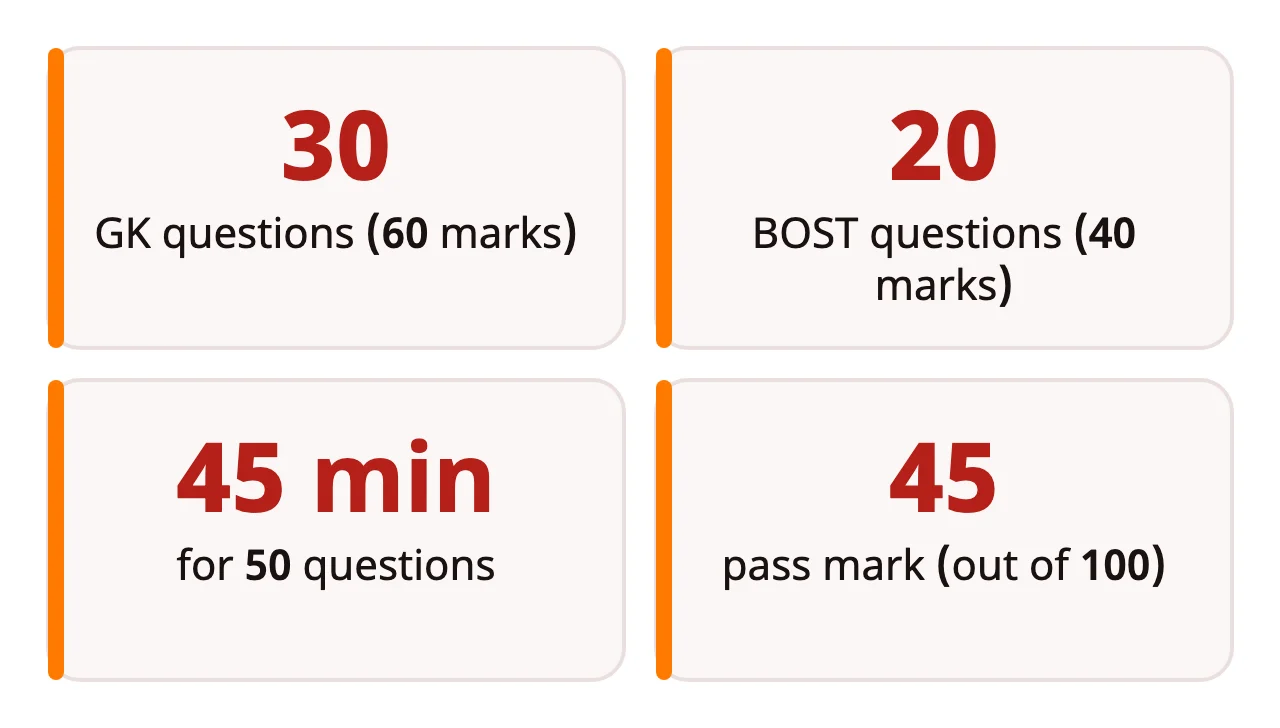
According to the Public Service Commission's syllabus, the Kharidar first paper is "General Knowledge and Basic Office Skills Test": 50 multiple-choice questions, 2 marks each, 45 minutes, pass mark 45. Six questions come from each of the five GK units and two from each of the ten BOST test types. A wrong answer loses 20 percent of the marks, and calculators are not allowed. The full detail is on the Kharidar first paper syllabus page.
Kharidar first paper preparation: the 30-day plan
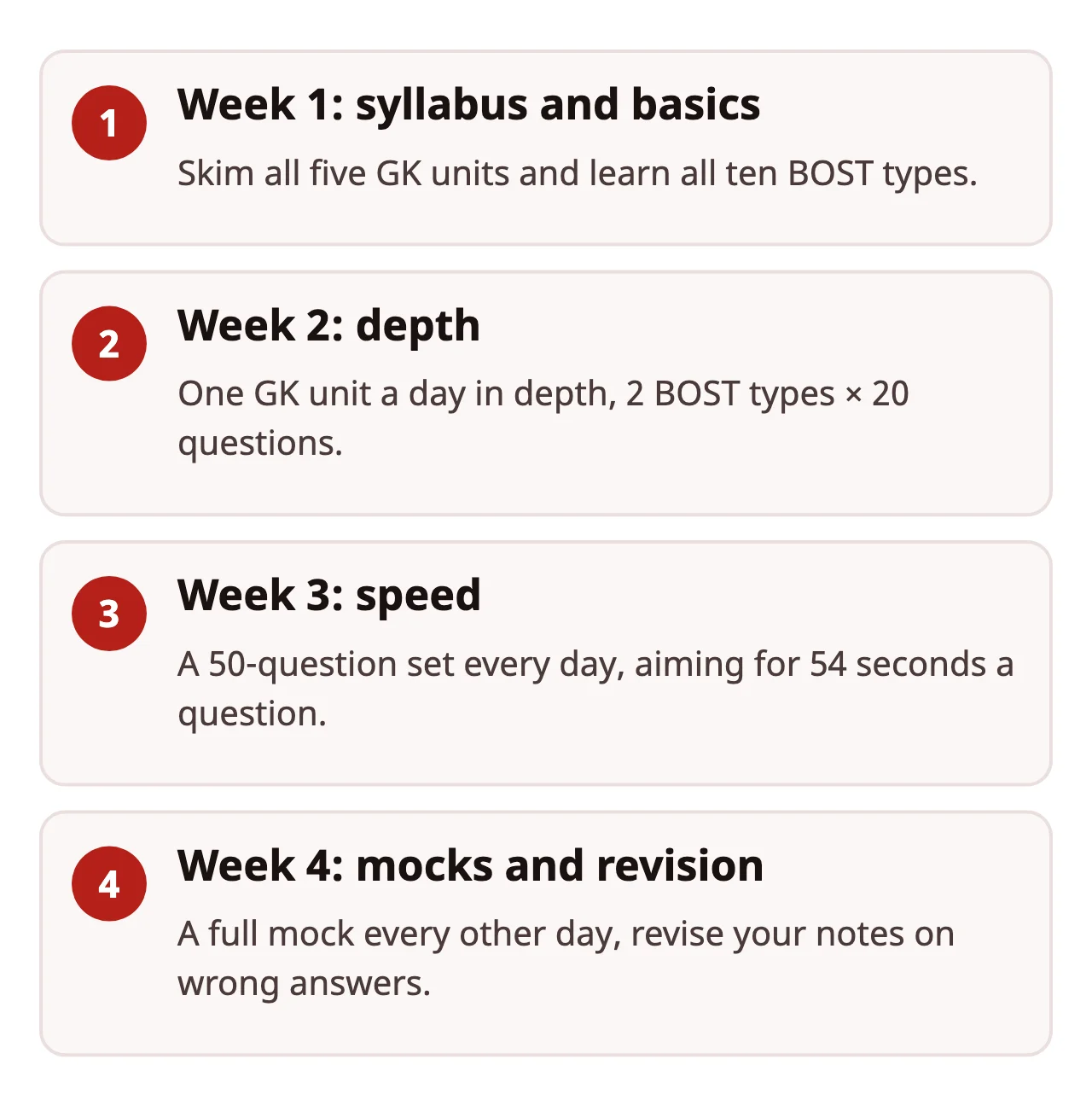
Week 1 (days 1 to 7): the syllabus and the basics
On day one, print the syllabus and note the units and the number of questions. Then skim one GK unit each day: the solar system and geography; history; society, economy and governance; science, health and environment; and international relations with current affairs. In the evening, look at sample questions from two of the ten BOST types (verification, completion, classification, analogy, filing, instructions, numerical, coding, analytical, direction and distance). On day seven, sit a short 25-question test.
Week 2 (days 8 to 14): depth
This week, study each GK unit in depth, one a day. Understand connections rather than memorising facts: which river is in which province, which event happened in which year and why. In the evening, do 20 timed questions each from two BOST types. By the end of the week, you should have done questions from all ten BOST types at least once.
Week 3 (days 15 to 21): speed
Now it is time to get faster. Every day, do one 50-question set in exactly 45 minutes. At first you may run out of time; that is normal. Note which types take the longest and practise those more the next day. In GK this week, give extra time to current affairs and the constitution, because they come up again and again.
Week 4 (days 22 to 30): mock tests and revision
Sit a full mock test every other day, at the same time of day as the real exam (morning or afternoon). On days without a mock, revise your notes on wrong answers and your weak units. On the last two days, do not study anything new; look only at your notes and formulas.
Daily timetable
- Morning (90 minutes): a new GK unit, or depth on one.
- Afternoon (45 minutes): 25 questions on the morning's unit.
- Evening (60 minutes): BOST practice, against the clock.
- Night (30 minutes): notes on wrong answers and current affairs.
If you study alongside a job or college, you can stretch this timetable over six weeks.
How to raise your GK marks
Each unit gives the same six questions, so do not spend all your time on one unit. Under the syllabus, about 60 percent of questions are Level I (simple multiple choice) and 40 percent are Level II (matching, true or false, cause and effect); in Level II questions, read every option before you answer.
How to save time in BOST
BOST questions look easy, but this is the part that eats time. Get used to doing verification and classification questions in 30 to 40 seconds, so more time is left for numerical and analytical questions. Each type is explained with an example in our BOST loksewa guide, and you can practise with the BOST sample questions (in Nepali).
Strategy in the exam hall
- First pass (25 minutes): finish every question you are sure of; mark the ones that slow you down and move on.
- Second pass (15 minutes): go back to the marked questions; answer only those where you can rule out two options.
- Last 5 minutes: check that your roll number, set and bubbles are filled in correctly on the answer sheet.
Because a wrong answer loses 0.4 marks, do not answer by pure guessing. You can work out when guessing pays in the negative marking calculator, and the reasoning is in our negative marking loksewa guide.
Practice resources
- Free (in Nepali): Kharidar GK sample questions and sets on geography, history and the constitution.
- The Dipa App has Kharidar GK and BOST practice questions, AI-picked tests from your weak topics and daily questions; see what we offer.
Check yourself at the end of each week
Every Sunday, spend 15 minutes reviewing your week. Write the answers to these four questions in a notebook:
- How many GK units did I finish this week, and in how many am I still unsure?
- Which BOST types took the most time?
- How many questions were right, wrong and skipped in the mock test, and what was my score after negative marking?
- Which two things will I give more time to next week?
This review fits the plan to where you really are. If your marks are rising, the plan is working; if they do not rise for two weeks, cut down on new study and practise the units you got wrong.
How to cover current affairs
The fifth GK unit (international relations and current affairs) gives six questions, and books alone are not enough for it. Keep a habit of 15 minutes of current affairs every day for the 30 days: the government's main decisions, appointments, new laws, sports, awards and international meetings. We publish a daily news summary (in Nepali) with source links every day and a weekly summary with questions at the end of the week. In the last week before the exam, revise a short list of the main events of the past six months.
Using old questions
The Commission's old questions show what kind of questions are asked, but the syllabus changed from FY 2081/82, so old papers will not repeat as they were. Use them to understand the style, not to memorise. BOST in particular is new in this syllabus, so practise it with questions in the new format.
The last three days before the exam
- Three days before: your last mock test, at the exam time; no new tests after it.
- Two days before: only your notes on wrong answers, formulas and the current affairs list.
- One day before: your admit card, identity card, pens and the route to the exam centre ready; a good night's sleep.
Picking up a new topic on the last day lowers your confidence. Trust what you have already studied.
The same plan with less time
If you cannot give six hours a day, you can complete the same plan in 45 days. Keep one hour of GK in the morning, one hour of BOST and current affairs in the evening, and a full mock test on Saturdays. Spread the work of weeks 1 and 2 over three weeks, but do not cut the speed practice and mock tests of weeks 3 and 4, because that is where your marks rise. Doing 20 to 25 questions on your phone while travelling or at lunch adds half an hour to your day. If you miss the morning live class, you can watch the recording later; see how live classes work.
Conclusion
Regularity and timed practice are the keys to preparing the first paper in 30 days. Week one is the base, week two depth, week three speed and week four mock tests. Measure your progress every week and give more time to your weak spots. See the full exam format on the Kharidar exam pattern page, and the overview of every stage on Kharidar preparation.
Frequently asked questions
Can I pass the Kharidar first paper in 30 days?
It is possible for those who study four to five hours a day regularly and already have some basic knowledge. If you are starting from zero, stretch this plan to six weeks.
What is the first-paper pass mark?
45 out of 100. Because it is a screening exam, you may need more than 45 to reach Stage II, depending on competition.
Should I study GK or BOST first?
Both together: a new GK unit in the morning and BOST practice in the evening. BOST questions only get faster with daily practice.
Sources
- Kharidar or equivalent syllabus: Stage I (PDF, Nepali), Public Service Commission (2024-07-25)
Courses for this topic
Kharidar First Paper Pack: Pass the Screening
GK, BOST, mock tests and weekly current affairs for the Kharidar screening, in one pack.
Kharidar General Knowledge (GK): Paper I
The 60-mark GK part of the Kharidar first paper: all five units with video, notes and MCQ practice.
Kharidar Basic Office Skills Test (BOST): Paper I
The 40-mark BOST: tricks for all ten question types and timed drills.

Study in the Dipa App
Buy courses, join Live Classes and practise every day in the app. Payment works inside the app with eSewa.

Author
Dipa Academy editorial team
Dipa Academy's editorial team writes Lok Sewa guides from the Public Service Commission's official syllabus, notices and results, and cites every source.
Read next
Top 10 Loksewa Institutes in Nepal (2026): How to Choose
21 November 2026 (मंसिर ५, २०८३)Loksewa GK Strategy: 60 Marks of General Knowledge
21 November 2026 (मंसिर ५, २०८३)Loksewa Preparation With a Job: a Two-Hour Daily Plan
21 November 2026 (मंसिर ५, २०८३)