
Nayab Subba Syllabus 2083: Nasu Papers, Marks and Rules
The official Nayab Subba (Nasu) syllabus of the Public Service Commission, in force since the FY 2081/82 advertisements: Paper I general knowledge and General Mental Ability, Paper II contemporary studies and public service management, Paper III by service group, and the final stage.
The Public Service Commission (PSC) has published the syllabus for Nayab Subba (Nasu, नायब सुब्बा) or equivalent posts (non-gazetted first class), in force from the FY 2081/82 advertisements. The same Nayab Subba syllabus applies to the FY 2083/84 exams. This page shows the structure and rules of all three papers; each paper has its own page with the unit detail.
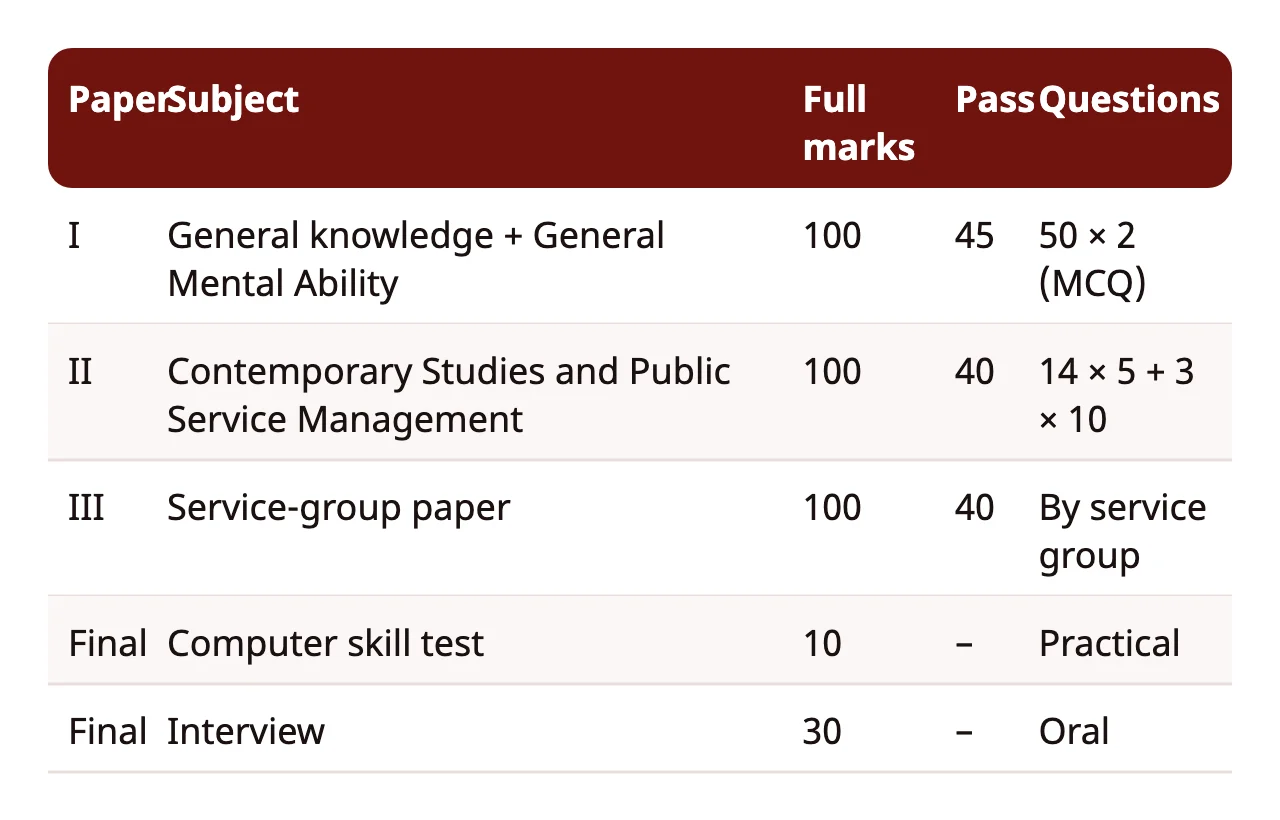
Nayab Subba syllabus: the structure
Paper I: general knowledge and General Mental Ability
Thirty questions (60 marks) from the 11 sub-units of general knowledge and 20 questions (40 marks) from the General Mental Ability test, often called GMAT or IQ. The syllabus fixes the number of questions from each sub-unit. In detail: Nasu first paper syllabus.
Paper II: Contemporary Studies and Public Service Management
Three sections: Nepal's geographical, social and economic conditions (35), constitutional provisions and government (35), and public service operation and management (30). In detail: Nasu second paper syllabus.
Paper III: the service-group paper
It differs by service group. The third paper of the General Administration group and the Parliament Service has office operation and organisational behaviour (35), administration and management (35), and the legal provisions on public service management (30). In detail: Nasu third paper syllabus.
The final stage
The computer skill test (10 marks, practical, 15 minutes) and the interview (30 marks). The typing and Word tasks are explained in our Lok Sewa computer test guide.
Important rules in the syllabus
- Stage I is a screening exam only; the pass mark is 45 and its marks are not added to the main exam.
- In multiple-choice questions, 20 percent of the marks are deducted for a wrong answer; nothing for a blank.
- Calculators are not allowed in the multiple-choice exam.
- The written exam may be answered in Nepali, English or both.
- In subjective papers, the answers to each section go in a separate answer book.
- The final result is worked out from the total of Stage II and the final stage.
An order of study that follows the syllabus
- First paper first: the heavy GK sub-units (current events 5, Nepal's geography 4, social and cultural life 4 questions) and all three parts of the General Mental Ability test.
- Second paper alongside: the constitution, federalism and economy parts match the first paper, so studying them together saves time.
- Third paper after that: only once you have confirmed your service group in the advertisement.
- Regularly: two written answers a week, current affairs every day and ten minutes of typing.
The marks and time of each stage are on the Nayab Subba exam pattern page, and the pass mark of every paper in our Nasu pass mark guide. Our Nasu courses follow the same structure, one course for each paper; they are listed on Nayab Subba preparation.
How the Nasu syllabus differs from Kharidar
Both first papers have 30 general knowledge questions, but the Nasu syllabus sets a fixed number of questions for each of its 11 sub-units, while Kharidar takes 6 from each of five units. The other 20 questions are the General Mental Ability test for Nasu and the Basic Office Skills Test for Kharidar. In Stage II, Kharidar has the same two papers for everyone, while Nasu has a common second paper and a third paper that depends on the service group. The final stage is the same for both.
Where to find the official PDFs
The Commission publishes the syllabus as two PDF files in Nepali: Stage I and Stage II. If anything here differs from those files, the PDFs are final.
Frequently asked questions
Is the Nasu syllabus the same for every service group?
Papers I and II are the same for all groups of the Judicial, Foreign Affairs, Administration, Audit and Parliament services. Paper III differs by service group.
In which language can I write the Nasu written exam?
According to the syllabus, in Nepali, English or both. The Foreign Affairs third paper (English language and diplomatic subjects) is in English only.
Are the first paper marks added to the final result?
No. Stage I is only a screening exam with a pass mark of 45. The final result comes from Stage II and the final stage.
Sources
- Nayab Subba or equivalent syllabus: Stage I (PDF, Nepali), Public Service Commission (2024-07-25)
- Nayab Subba or equivalent syllabus: Stage II (PDF, Nepali), Public Service Commission (2024-07-25)
Courses for this topic
Nayab Subba Complete Preparation Pack: General Administration
Nasu screening, second and third papers, computer test and interview, in one payment.
Nayab Subba General Knowledge (GK): Paper I
The 60-mark GK part of the Nasu first paper, with video, notes and MCQ practice.
Nayab Subba IQ / GMAT (General Mental Ability): Paper I
The 40-mark Nasu IQ test: verbal, quantitative and non-verbal reasoning with tricks and drills.

Study in the Dipa App
Buy courses, join Live Classes and practise every day in the app. Payment works inside the app with eSewa.

Author
Dipa Academy editorial team
Dipa Academy's editorial team writes Lok Sewa guides from the Public Service Commission's official syllabus, notices and results, and cites every source.
Read next
Nasu Third Paper: a Different Paper per Service Group
21 November 2026 (मंसिर ५, २०८३)Nasu Second Paper: Contemporary Studies and Public Service
21 November 2026 (मंसिर ५, २०८३)Kharidar Third Paper: the Acts, Accounts and Law to Study
21 November 2026 (मंसिर ५, २०८३)