
Nasu Second Paper: Contemporary Studies and Public Service
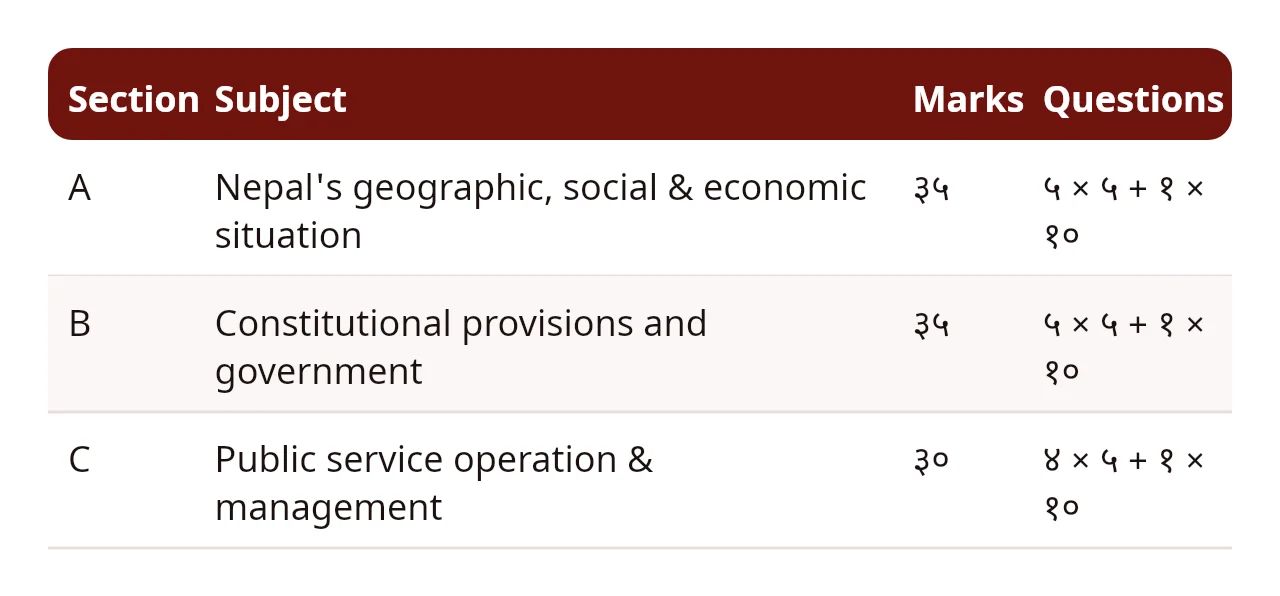
The Nayab Subba second paper is a 100-mark written exam: Nepal's geographic, social and economic situation 35, constitutional provisions and government 35, public service operation 30. The sections, the analytical answer format and a six-week plan.
The nasu second paper — contemporary studies and public service management — is a 100-mark written exam of seventeen questions in two and a half hours, pass mark 40, common to every Nayab Subba service group. It rewards a different skill from the first paper: short analytical writing backed by current numbers.
Section A: Nepal's situation (35 marks)
Geography, demography and the economy as they stand now: the census headlines, the current budget's size and priorities, growth and remittance figures, development indicators. The facts come from the geography guide and a maintained current-affairs notebook; the skill is fitting them into one-page answers.
Section B: constitution and government (35 marks)
The constitution's structures applied in writing: federalism in practice, the three tiers' powers, constitutional bodies at work, election systems. The MCQ facts from the constitution guide return here wearing analytical clothes: "How has federalism changed service delivery?" wants structure + two facts + a balanced judgement.
Section C: public service operation (30 marks)
Public service values, service delivery standards, the citizen charter, grievance handling, e-governance and good governance. Serving candidates should mine their office experience for examples; everyone else can borrow concrete examples from the news.
The analytical answer format
For 5 marks: direct position (1-2 sentences) → three numbered points, each with a fact → one balanced closing line. For 10 marks, add a short introduction and a two-sided view before the close. Current numbers — this budget, this census, this index — lift an answer from average to top band.
Collecting fresh facts
Keep a one-page "numbers sheet": budget total and key allocations, growth rate, inflation, remittances, population headlines, HDI. Update it monthly from official sources; our weekly digests link each number's source so you can verify. Walk into the hall with the sheet memorised.
The six-week plan
- Weeks 1-2: section B structures + numbers sheet started; two written answers per week.
- Weeks 3-4: section A themes; three answers per week, timed.
- Week 5: section C with examples; one full timed paper.
- Week 6: second full paper, numbers-sheet refresh, format drills.
Common mistakes
Writing GK essays with no current figures; one-sided opinions on political questions; ignoring section C as "common sense"; and never writing by hand under time. The third paper guide completes the written stage, and the written courses include checked answer practice.
Frequently asked questions
How many questions does the Nasu second paper have?
Seventeen questions worth 100 marks: fourteen of 5 marks and three of 10 marks, in 2 hours 30 minutes, with a pass mark of 40.
What are the Nasu second paper's sections?
Section A Nepal's geographic, social and economic situation (35 marks: 5×5 + 1×10), section B constitutional provisions and government (35 marks: 5×5 + 1×10) and section C public service operation and management (30 marks: 4×5 + 1×10).
Is the second paper the same for every service group?
Yes. Under the syllabus the first and second papers are common to all the service groups — justice, foreign affairs, administration, audit and parliament; only the third paper differs by group.
Sources
- Nayab Subba or equivalent syllabus: second paper (PDF, Nepali), Public Service Commission (2024-07-25)
Courses for this topic
Nayab Subba Second Paper: Contemporary Studies and Public Service Management
The 100-mark Nasu second paper: geography and economy, the constitution and federalism, and public service, with answer…
Nayab Subba Written Exam Pack: Second and Third Papers
The 200 marks of the Nasu written exam: the second and third papers in one pack.
Nayab Subba Complete Preparation Pack: General Administration
Nasu screening, second and third papers, computer test and interview, in one payment.

Study in the Dipa App
Buy courses, join Live Classes and practise every day in the app. Payment works inside the app with eSewa.

Author
Dipa Academy editorial team
Dipa Academy's editorial team writes Lok Sewa guides from the Public Service Commission's official syllabus, notices and results, and cites every source.
Read next
Nasu Third Paper: a Different Paper per Service Group
21 November 2026 (मंसिर ५, २०८३)Kharidar Third Paper: the Acts, Accounts and Law to Study
21 November 2026 (मंसिर ५, २०८३)Kharidar Second Paper: Office Management, Constitution, Maths
21 November 2026 (मंसिर ५, २०८३)