
Nayab Subba Exam Pattern: Stages, Marks, Time and Pass Marks
The official Nayab Subba (Nasu) exam pattern: Stage I general knowledge and General Mental Ability, the two written papers, the computer test and interview, negative marking and time planning.
The Nayab Subba (Nasu, नायब सुब्बा) exam has three stages like Kharidar, but the first paper has the General Mental Ability test (often called GMAT or IQ) instead of BOST, and the third paper changes with the service group. This Nayab Subba exam pattern is based on the Public Service Commission's syllabus in force since FY 2081/82.
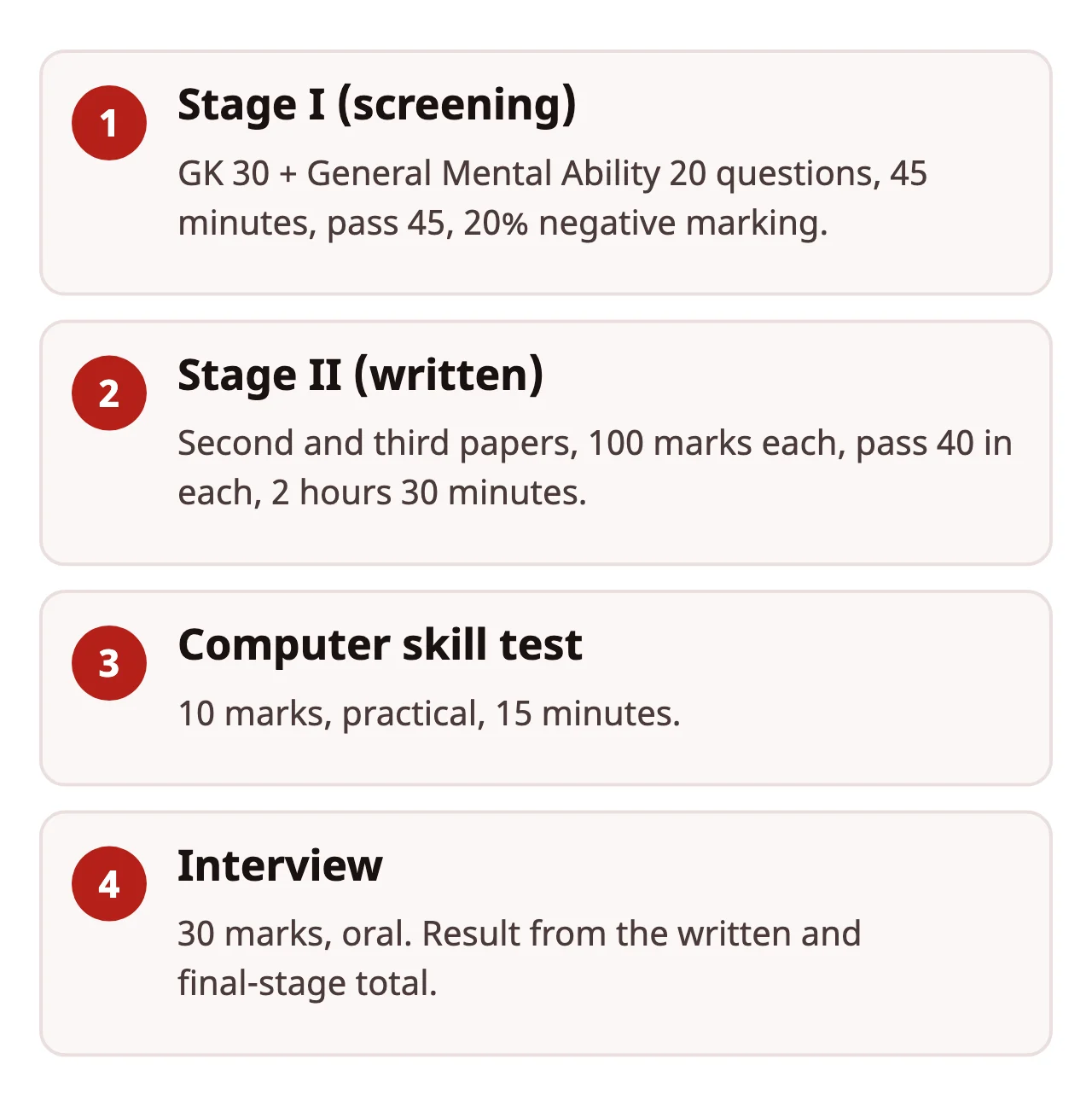
Nayab Subba exam pattern: the full table
| Stage | Paper | Full marks | Pass | Type | Questions × marks | Time |
|---|---|---|---|---|---|---|
| I | General knowledge + General Mental Ability | 100 | 45 | Objective (MCQ) | 50 × 2 | 45 minutes |
| II | Contemporary Studies and Public Service Management | 100 | 40 | Subjective | 14 × 5 + 3 × 10 | 2 hours 30 minutes |
| II | Service-group paper | 100 | 40 | Subjective | As the syllabus sets | 2 hours 30 minutes |
| Final | Computer skill test | 10 | – | Practical | – | 15 minutes |
| Final | Interview | 30 | – | Oral | – | – |
Stage I: the screening exam
- 30 general knowledge questions (60 marks) and 20 General Mental Ability questions (40 marks): 6 verbal, 8 quantitative and 6 non-verbal.
- Each wrong answer loses 20 percent (0.4 marks); a blank loses nothing.
- Calculators are not allowed.
- The pass mark is 45, and these marks are not added to the main exam.
The quantitative reasoning questions take longer, so get used to finishing the easy GK questions quickly. Work out the risk of a guess in the negative marking calculator, and practise the reasoning types with our Lok Sewa IQ questions guide.
Stage II: the written exam
Only those selected in Stage I sit it. The second paper is the same for every service group; the third paper depends on the group. You can answer in Nepali, English or both, except the third paper on English language and diplomatic subjects, which is answered in English only. Each section's answers go in a separate answer book.
Time maths: the second paper has 17 questions in 150 minutes. Giving about 7 minutes to a 5-mark question and about 14 minutes to a 10-mark question leaves time to revise at the end. What the papers cover is on the second paper syllabus and third paper syllabus pages.
Final stage
The computer skill test (10 marks, 15 minutes) and the interview (30 marks). The computer test has typing and Word tasks; practise with our Nepali typing test and read the Lok Sewa computer test guide. The final result is made from the total of the written exam and the final stage.
How the final result is calculated
Nayab Subba has 240 marks that count: 200 from the two written papers and 40 from the final stage (computer test 10, interview 30). The 100 marks of Stage I only decide who goes on, so after the screening every candidate starts the written exam equal. The written exam therefore matters most: its three 10-mark questions in the second paper, and the 10-mark questions in the third paper, separate candidates more than any other part. The final stage then decides close cases, and typing is the easiest of those marks to improve with daily practice.
Time plan for the first paper
Fifty questions in 45 minutes leaves about 54 seconds each. A practical plan is to answer the general knowledge questions you know in the first 15 minutes, spend about 25 minutes on the 20 reasoning questions, and use the last 5 minutes for the questions you marked to come back to.
What this pattern teaches you
- 45 is the Stage I pass mark, not a target; selection depends on competition.
- The 20 General Mental Ability questions (40 marks) are the part that improves most with practice.
- The three 10-mark questions in the written exam decide results.
- Check your service group in the advertisement before you choose a third paper.
All pass marks are side by side in our Nasu pass mark guide. The syllabus units are on the Nayab Subba syllabus page and the courses on Nayab Subba preparation.
Frequently asked questions
What is the Nasu pass mark?
45 out of 100 in Stage I, and 40 out of 100 in each of the two Stage II written papers.
How long is the Nasu first paper?
45 minutes for 50 multiple-choice questions, about 54 seconds per question on average.
How many 10-mark questions are in the Nasu written exam?
The second paper has 3 (one from each section) and 14 five-mark questions. The third paper depends on the service group's syllabus; General Administration also has one 10-mark question per section.
Sources
- Nayab Subba or equivalent syllabus: exam plan (PDF, Nepali), Public Service Commission (2024-07-25)
Courses for this topic
Nayab Subba Complete Preparation Pack: General Administration
Nasu screening, second and third papers, computer test and interview, in one payment.
Nayab Subba First Paper Test Series (Mock Tests)
Old questions, full mock tests and GK and IQ practice sets for the Nasu first paper, marked like the exam.
Lok Sewa Computer Skill Test and Typing
The 10-mark final-stage computer test: Windows, MS Word, Nepali and English typing.

Study in the Dipa App
Buy courses, join Live Classes and practise every day in the app. Payment works inside the app with eSewa.

Author
Dipa Academy editorial team
Dipa Academy's editorial team writes Lok Sewa guides from the Public Service Commission's official syllabus, notices and results, and cites every source.
Read next
Nasu Third Paper: a Different Paper per Service Group
21 November 2026 (मंसिर ५, २०८३)Nasu Second Paper: Contemporary Studies and Public Service
21 November 2026 (मंसिर ५, २०८३)Kharidar Third Paper: the Acts, Accounts and Law to Study
21 November 2026 (मंसिर ५, २०८३)