
IQ Questions Loksewa: A Full Guide to the Nasu General Mental Ability Test
IQ questions in Lok Sewa (the Nayab Subba General Mental Ability test): the three parts and their questions, worked examples of each type, quick methods, common mistakes, a four-week plan and exam-hall timing.
Of the 50 questions in the Nayab Subba (Nasu, नायब सुब्बा) first paper, 20 come from the General Mental Ability test, and this part carries 40 marks. Most people call it "IQ" (some call it GMAT). The good thing about IQ questions loksewa candidates face is that there is little to memorise: learn the question types and practise regularly, and your marks rise quickly. This guide covers all three parts of the syllabus, an example of each type, quick methods and a practice plan.
IQ questions loksewa: what the syllabus says
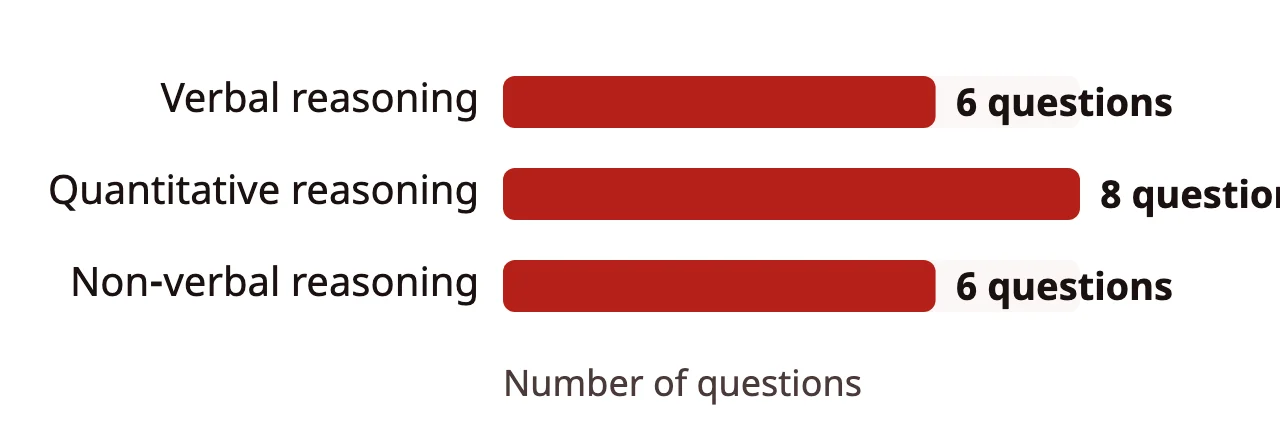
According to the Public Service Commission's syllabus, the General Mental Ability test has three parts: 6 questions from verbal reasoning, 8 from quantitative (numerical) reasoning and 6 from non-verbal reasoning. Each question is worth 2 marks and a wrong answer loses 0.4. The whole first paper lasts 45 minutes, and calculators are not allowed.
The sample questions in the syllabus include ranking, letter and number series, missing numbers, coding, the least common multiple, counting triangles, picture matrices and averages, and one of them offers "data inadequate" as an option. That shows why you must read every question in full before choosing. The full unit table is on the Nasu first paper syllabus page.
Verbal reasoning (6 questions)
This part covers comprehension, vocabulary, series, analogy, classification, coding-decoding, missing letters, direction and distance, logical analysis, ranking, statement and reason, induction, deduction and sequences of actions or situations.
Example (coding): if CAT is written as DBU in a code, how is DOG written? Each letter moves one place forward, so the answer is EPH.
Example (ranking): Ram is 12th from the front in a line of 40. What is his position from the back? Formula: total − position + 1 = 40 − 12 + 1 = 29th.
Method: in coding, do not test the rule on the first two letters only; check that it works for every letter. Remembering the positions of letters in the alphabet (A = 1, E = 5, J = 10, O = 15, T = 20) makes both coding and series faster.
Quantitative reasoning (8 questions)
This part gives the most questions. It covers series, analogy, classification, coding, missing numbers, common properties, matrices, data interpretation and verification, arithmetic operations, percentages, fractions, decimals, ratios, averages, profit and loss, dates and calendars, and time and work.
Example (series): 3, 6, 11, 18, 27, ? The differences grow 3, 5, 7, 9, so the next difference is 11; the answer is 38.
Example (average): the average of five numbers is 20. When one number is removed, the average of the other four is 18. What was removed? Total 100 − 72 = 28.
Example (time and work): A finishes a job in 10 days and B in 15 days. How long do they take together? One day's work is 1/10 + 1/15 = 1/6, so 6 days.
Example (percentage): a price rises by 20 percent and then falls by 20 percent. What is the overall change? 100 → 120 → 96, that is 4 percent less.
Method: learn the squares from 1 to 20, the cubes from 1 to 10 and common fractions as percentages (1/4 = 25%, 1/8 = 12.5%). Working backwards from the options also solves many questions quickly.
Non-verbal reasoning (6 questions)
This part is based on pictures: series, analogy, classification, logical picture analysis, Venn diagrams, picture matrices, counting squares and triangles, building figures, dot positions, water and mirror images, embedded figures and the movement of figures.
Example (Venn diagram): to show "teachers, women, Nepalis", you need three overlapping circles, because some Nepali women are teachers and some are not.
Method: in a mirror image, left and right swap while top and bottom stay; in a water image, top and bottom swap. In a picture series, watch one element at a time (corners, rotation, shading or number). When counting triangles, count from small to large so you do not count any twice.
Common mistakes
- Not reading the whole question: choosing the matching one when it asks for the odd one, or writing a position when it asks how many people are in between.
- Getting stuck on one question: three minutes on one question costs you two easy ones.
- Forgetting the "data inadequate" option: the syllabus's own sample offers it; if the facts given are not enough, it can be the right answer.
- Doing all the maths in your head: writing two lines of working on paper cuts mistakes a lot.
How to practise IQ
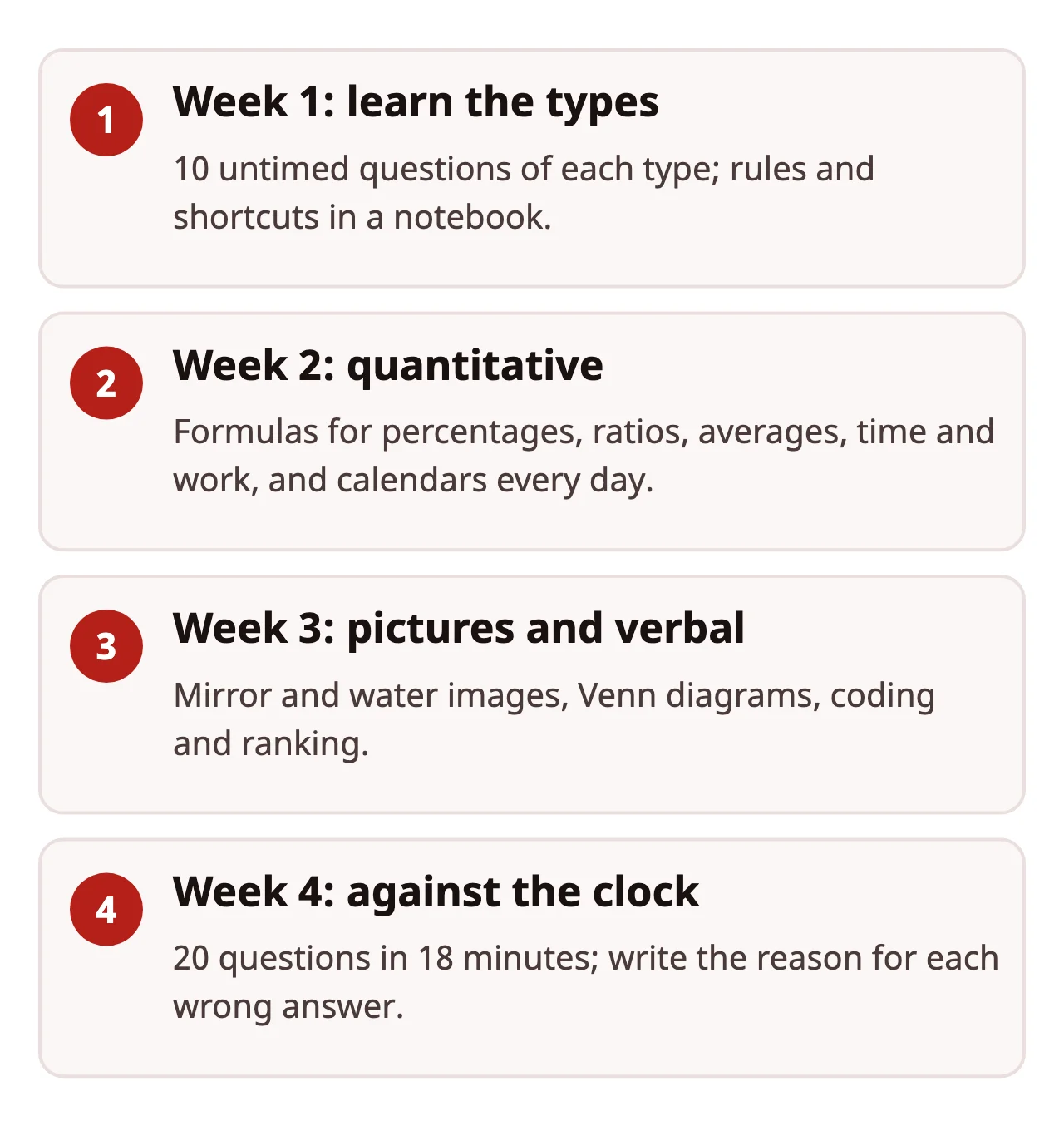
Give IQ 30 minutes a day: the first 15 minutes on a new type, the other 15 on timed mixed questions. Write down the reason for every wrong answer (did not know the rule, made a calculation slip, misread the question); within two weeks your weak types show themselves. To start, the IQ sample questions (in Nepali) have answers and explanations.
The Dipa App has practice questions and tests in the Nayab Subba IQ course, and its AI picks more questions from the types you are weak in; see AI Lok Sewa preparation.
Managing time in the exam hall
Fifty questions in 45 minutes is an average of 54 seconds a question. If you can finish the 30 GK questions in 15 to 18 minutes, about 20 minutes are left for IQ. In IQ, first do the questions you can solve within a minute, mark the hard ones, move on and come back at the end.
Should you guess? If you can rule out two options for certain, answering pays mathematically; the details are in our negative marking loksewa guide and the negative marking calculator.
How is it different from Kharidar BOST?
The Kharidar (खरिदार) first paper has the Basic Office Skills Test (BOST) instead of IQ. Series, classification, coding, direction and numerical questions appear in both, but BOST adds office skills such as verification, filing and following instructions, while the Nasu IQ test has a separate picture-based non-verbal part. If you are sitting both exams, start with the shared types; BOST is explained in our BOST loksewa guide.
Calendar, clock and data questions
The quantitative part names calendars and data interpretation in the syllabus itself. With the rule in hand, these take less than a minute.
Example (calendar): if the 1st of a month is a Monday, what day is the 22nd? It is 21 days later, exactly three weeks, so Monday again. Count only the days left over after dividing by 7.
Example (clock): what is the angle between the hour and minute hands at 3 o'clock? There are 30 degrees between each hour mark, so 3 × 30 = 90 degrees.
Example (data interpretation): an office served 200 people in the first year and 250 in the second. What is the percentage increase? (250 − 200) ÷ 200 × 100 = 25 percent. In data questions, first identify what is asked (a difference, a percentage, an average or a ratio), then calculate.
Example (ratio): divide Rs 60 in the ratio 2:3. What is the larger share? Five parts in total, one part is 12, so the larger share is 3 × 12 = Rs 36.
When should you start IQ preparation?
Because GK takes so long to read, many people leave IQ for the last month. That is a mistake. Speed and accuracy in IQ grow slowly, so give IQ a little time every day from the first week of preparation. When GK and IQ move forward together, there is enough time to revise both in the final month.
Conclusion
Scoring in IQ needs practice, not talent. Learn the types in all three parts, keep formulas and shortcuts in a notebook, and in the last two weeks do full timed sets. The overall plan is on Nayab Subba preparation, and the pass mark of every paper is in our Nasu pass mark guide.
Frequently asked questions
How many IQ questions are in the Nayab Subba exam?
Twenty of the 50 first-paper questions come from the General Mental Ability test, 2 marks each, so 40 marks. Under the syllabus, 6 are verbal, 8 quantitative and 6 non-verbal.
Can I use a calculator in the IQ part?
No. Under the PSC syllabus no calculator of any kind is allowed in a multiple-choice exam, so practise quick mental and paper working.
How many marks do I lose for a wrong IQ answer?
20 percent of that question's marks, that is 0.4 marks, for each wrong answer. A question you leave blank gets no marks and loses none.
Sources
- Nayab Subba or equivalent syllabus: general knowledge and General Mental Ability (PDF, Nepali), Public Service Commission (2024-07-25)
Courses for this topic
Nayab Subba IQ / GMAT (General Mental Ability): Paper I
The 40-mark Nasu IQ test: verbal, quantitative and non-verbal reasoning with tricks and drills.
Nayab Subba First Paper Pack: GK + IQ + Mock Tests
GK, IQ (GMAT), mock tests and weekly current affairs for the Nasu screening, all in one place.
Nayab Subba First Paper Test Series (Mock Tests)
Old questions, full mock tests and GK and IQ practice sets for the Nasu first paper, marked like the exam.

Study in the Dipa App
Buy courses, join Live Classes and practise every day in the app. Payment works inside the app with eSewa.

Author
Dipa Academy editorial team
Dipa Academy's editorial team writes Lok Sewa guides from the Public Service Commission's official syllabus, notices and results, and cites every source.
Read next
History of Nepal for Loksewa: the Dates That Score
21 November 2026 (मंसिर ५, २०८३)Geography of Nepal for Loksewa: Facts the Exam Asks
21 November 2026 (मंसिर ५, २०८३)Current Affairs for Loksewa: a 20-Minute Daily Method
21 November 2026 (मंसिर ५, २०८३)