
Negative Marking in Loksewa: When to Guess and When to Skip
The negative marking loksewa rule (20 percent of a question's marks for a wrong answer), how to work out your score, the maths of guessing, a three-pass strategy for the exam hall, and how to measure your own guessing rate in mock tests.
The Kharidar (खरिदार) and Nayab Subba (Nasu, नायब सुब्बा) first papers have 50 multiple-choice questions, and every wrong answer takes marks away. The rule for negative marking loksewa is simple, but many people find the decision in the exam hall hard: answer or skip? Some skip questions they actually know out of fear; others guess on everything. This article covers the rule, how to work out your marks, the maths of guessing and a practical strategy for the exam hall.
Negative marking loksewa: the Commission's rule
Both the PSC's Kharidar syllabus and Nayab Subba syllabus say the same thing: for every wrong answer to a multiple-choice question, 20 percent of the marks are deducted, but a question you do not answer gets no marks and loses none.
Each first-paper question is worth 2 marks, so:
- Right answer: +2 marks
- Wrong answer: −0.4 marks
- No answer: 0
Under the syllabus, calculators are not allowed in the multiple-choice exam, and the first-paper pass mark is 45. This paper is a screening exam only; its marks are not added to the main exam, but you cannot reach the written exam without passing it.
How to calculate your marks
The formula: marks = right answers × 2 − wrong answers × 0.4
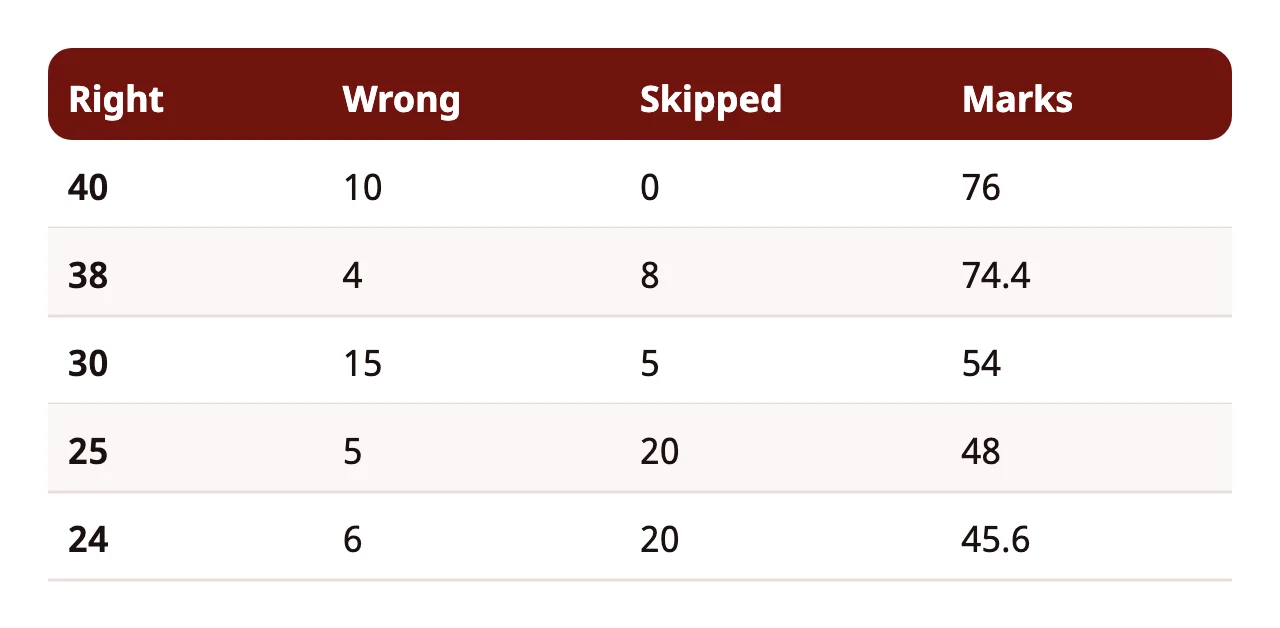
Look closely at the last two rows of the table. With 25 right and 5 wrong you score 48. With 24 right and 6 wrong you score only 45.6, very close to the pass mark. When one answer moves from right to wrong you lose 2.4 marks, because you lose the 2 marks for the right answer and 0.4 more is deducted.
Use this formula yourself after every mock test, or enter your right, wrong and skipped questions in our negative marking calculator.
The maths of guessing
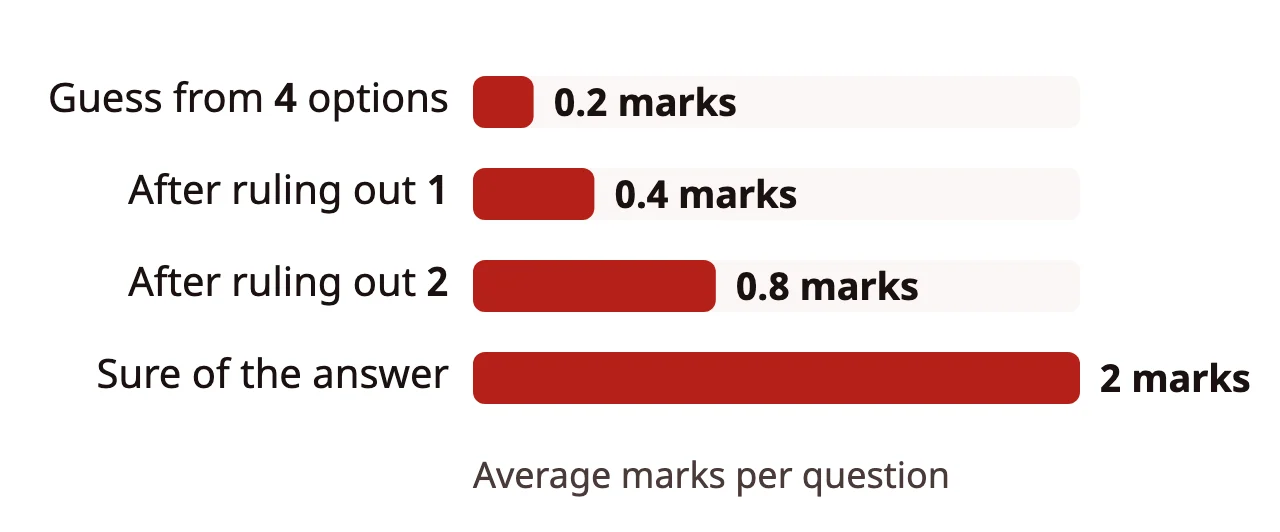
Suppose you have no idea about a question and all four options look equally likely. If you guess, your chance of being right is 1 in 4. On average (the expected value):
- Four options left: (1/4 × 2) − (3/4 × 0.4) = 0.5 − 0.3 = +0.2 marks
- One option ruled out for sure, three left: (1/3 × 2) − (2/3 × 0.4) ≈ 0.67 − 0.27 = +0.4 marks
- Two options ruled out, two left: (1/2 × 2) − (1/2 × 0.4) = 1 − 0.2 = +0.8 marks
The break-even point, where guessing neither helps nor hurts: if your chance of being right is p, then 2p − 0.4(1 − p) = 0 gives p = 1/6, about 17 percent. If your chance is better than 1 in 6, guessing raises your marks on average.
So should you guess on every question?
No, for three reasons:
- Tricky options: many PSC questions have two options that look alike. When you do not know the topic you are often pulled towards the "attractive" wrong option, so your real chance can be lower than 1 in 4.
- An average is not one exam: +0.2 is the average over many exams. In a single exam, 7 or 8 of 10 blind guesses can be wrong, which can cost you up to 3 marks.
- Time: getting stuck on guesses takes time away from the questions you know.
A practical rule: guess only after you can rule out at least one option for certain. If you can rule out two options, you should answer; skipping is throwing away marks.
A three-pass strategy for the exam hall
Pass one: the ones you know
Go from start to end and answer only the questions you are sure about. Mark the ones that slow you down on the question paper (for example with "?" or "×") and move on. This pass usually covers 60 to 70 percent of the questions.
Pass two: the ones you can narrow down
Go back to the marked questions. Cross out the wrong options one by one. Answer the ones you can narrow to two options; with three options left, answer only if your knowledge gives you a reason.
Pass three: the time that is left
Skip the questions you know nothing about. Use the remaining time to check that each bubble on the answer sheet matches its question number; one line out of place makes many answers wrong at once.
BOST and IQ are different
GK questions are the "you know it or you don't" type, but Kharidar's BOST and Nasu's IQ questions are worked out. Here the danger is less "not knowing" and more "a mistake in a hurry". Even when your answer matches an option, check it backwards once; for example, turn a percentage answer back into the original number. If your answer matches no option, do not guess: work it out again or skip it. BOST is covered in our BOST guide and IQ in the Lok Sewa IQ questions guide.
Measure your own guessing rate in mock tests
In every mock test, put a separate mark next to the questions you guessed. After the test, count: how many of your guesses were right? If over two or three tests more than 50 percent of your guesses are right, your "half-known" knowledge is reliable; if fewer than 25 percent are right, guess less. This turns the decision about how much risk to take in the exam hall into one based on your own record.
The Dipa App has a full first-paper test series and live mock tests at fixed times, and its AI analytics shows your strong and weak topics from your test history; see AI Lok Sewa preparation.
Common mistakes
- Skipping questions you know out of fear: skipping an answer you are 80 percent sure of loses more than 1.5 marks on average.
- Guessing on every blank in the last five minutes: filling bubbles in a hurry causes mistakes even on answers you know.
- Forgetting to line up the bubbles: marking the answer to question 15 on line 16 shifts every answer after it.
- Making the pass mark your target: 45 is the pass mark, not the selection mark; competition can push the cut-off higher.
The pass mark and selection are not the same
Scoring 45 in the first paper means you pass, but selection for the written exam depends on competition. Recent PSC results show the gap. In the FY 2083/84 pre-qualifying exam for Nayab Subba-level posts in organised institutions, 18,216 of 69,803 candidates (about 26 percent) were selected for the second stage, and in the Kharidar-level exam 26,063 of 74,473 (about 35 percent). The details are in our notices (in Nepali): Nasu preliminary result and Kharidar preliminary result.
So every mark counts. Four careless wrong answers cost 1.6 marks, and in a competition that many marks can separate hundreds of candidates.
An example of three mock tests
Suppose a student sits three mock tests in three weeks:
| Test | Right | Wrong | Skipped | Marks |
|---|---|---|---|---|
| First | 32 | 14 | 4 | 58.4 |
| Second | 33 | 8 | 9 | 62.8 |
| Third | 36 | 7 | 7 | 69.2 |
In the second test the right answers went up by only one, but the marks rose by 4.4, because guessing less cut the wrong answers from 14 to 8. In the third, revision raised the right answers too. Those two things, fewer wrong and more right, are the whole first-paper strategy.
Conclusion
Negative marking is not something to fear; it is something to calculate. A wrong answer costs 0.4, a blank costs nothing, and answering pays when you can rule out two options. Solving in three passes and measuring your guessing rate in mock tests give you safer and higher marks in the first paper. The full exam formats are on the Kharidar exam pattern and Nayab Subba exam pattern pages, and every pass mark is listed in our Lok Sewa pass mark guide.
Frequently asked questions
How many marks are deducted for a wrong answer in Lok Sewa?
20 percent of the question's marks for every wrong multiple-choice answer. In the Kharidar and Nasu first papers each question is worth 2 marks, so one wrong answer costs 0.4 marks.
Are marks deducted for a question I leave blank?
No. According to the syllabus, an unanswered question gets no marks and loses none.
Is guessing worth it?
Mathematically, guessing raises your average score when your chance of being right is more than 1 in 6 (about 17 percent). Tricky options can lower your real chance, so it is safest to guess only after you can rule out at least one option for certain.
Sources
- Kharidar or equivalent syllabus: exam plan and notes (PDF, Nepali), Public Service Commission (2024-07-25)
- Nayab Subba or equivalent syllabus: exam plan and notes (PDF, Nepali), Public Service Commission (2024-07-25)
Courses for this topic
Kharidar First Paper Test Series (Mock Tests)
Old questions, full mock tests and practice sets for the Kharidar first paper, marked like the real exam.
Nayab Subba First Paper Test Series (Mock Tests)
Old questions, full mock tests and GK and IQ practice sets for the Nasu first paper, marked like the exam.
Kharidar + Nayab Subba First Paper Combo
Sitting both exams after +2? Screening preparation for both at one price.

Study in the Dipa App
Buy courses, join Live Classes and practise every day in the app. Payment works inside the app with eSewa.

Author
Dipa Academy editorial team
Dipa Academy's editorial team writes Lok Sewa guides from the Public Service Commission's official syllabus, notices and results, and cites every source.
Read next
Top 10 Loksewa Institutes in Nepal (2026): How to Choose
21 November 2026 (मंसिर ५, २०८३)Loksewa GK Strategy: 60 Marks of General Knowledge
21 November 2026 (मंसिर ५, २०८३)Loksewa Preparation With a Job: a Two-Hour Daily Plan
21 November 2026 (मंसिर ५, २०८३)