
Current Affairs for Loksewa: a 20-Minute Daily Method
Kharidar asks six and Nayab Subba seven first-paper questions from international relations and current affairs, and the Nasu second paper has its own contemporary unit. What to read, where to read it, how to take one-line notes and how to revise before the exam.
Current affairs loksewa questions scare candidates because the material never stops growing — but the exam only harvests a narrow slice of it. Kharidar's first paper takes six questions from international relations and current activities, Nasu's first paper seven in all, and the Nasu second paper asks written questions from its contemporary unit. A 20-minute daily system covers all of it.
Which news is exam-worthy?
The commission asks about facts with official standing, not gossip: appointments to constitutional and senior posts, new laws, ordinances and policies, budget and economic indicators, international summits and treaties, sports results at medal level, and reports with rankings. If a story has a number, a date and an institution, it can become an MCQ. Political speculation, crime stories and celebrity news almost never can.
One-line notes that survive revision
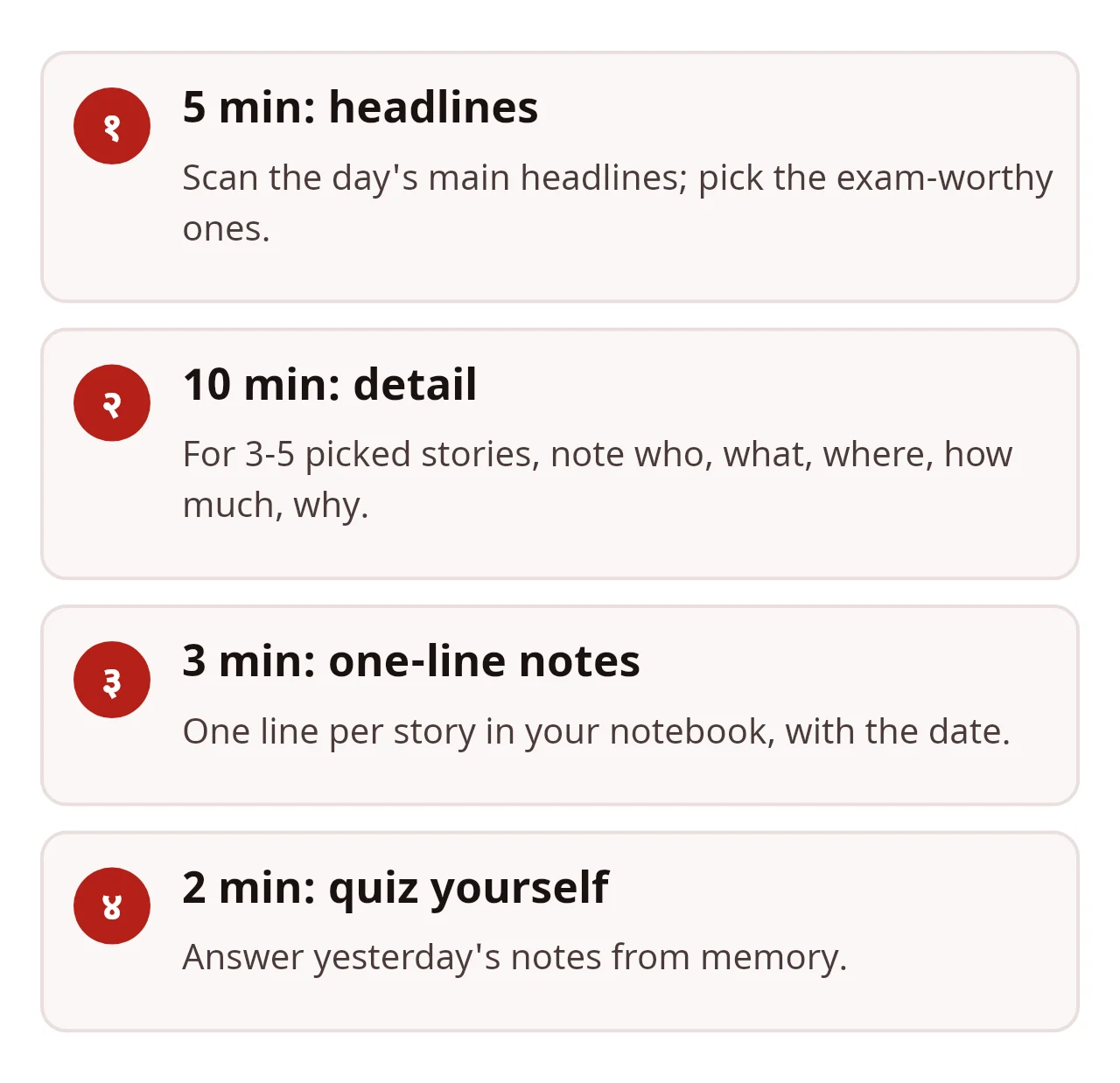
The note format that works: date — fact — number — source. For example: "2026-11-20 — Cabinet approved the National Suspension Bridge Policy 2026". One line per story, one notebook per month. Before the exam you revise twelve pages, not twelve newspapers.
Check facts at the source
Secondary sites get numbers wrong. For anything you will memorise, confirm once against the official source: psc.gov.np for commission notices, mof.gov.np for budget figures, nrb.org.np for monetary numbers. Our own daily news summaries and weekly digests link the source under every item precisely so you can check.
Monthly and final revision
At each month's end, turn the notebook page into ten self-made MCQs. In the final two weeks, re-read only the last six months of one-liners and the permanent-facts tables below. Spaced repetition beats one giant cram: the AI practice in the Dipa App schedules exactly that for you with a daily question set.
Permanent facts: international organisations
A fixed table earns marks every single year: UN (1945, New York, Nepal joined 1955), SAARC (1985, Kathmandu secretariat), BIMSTEC (1997, Dhaka secretariat), WTO (1995, Nepal joined 2004), plus the current heads of the major bodies. Keep it on one page and update the names quarterly.
For the Nasu second paper
The written paper wants short analytical answers on contemporary issues — federalism in practice, public service delivery, the economy. For each big theme, keep three facts and one balanced sentence of your own judgement ready. The Nasu second paper guide shows the answer format.
Common mistakes
Reading three newspapers but writing nothing; collecting notes for months and never quizzing; and memorising stale names after a reshuffle. Twenty minutes a day with a notebook beats three unfocused hours.
Start today: the current affairs page has this week's digest with practice questions, free.
Frequently asked questions
How many current-affairs questions come in Lok Sewa?
Kharidar's first paper asks six questions from international relations and current activities; Nasu's first paper asks five from contemporary events plus two from international relations. The Nasu second paper adds written questions.
How many months of current affairs should I cover?
A practical window is the twelve months before the exam, weighted towards the last six. Permanent facts (organisations, treaties) matter in every cycle.
Where should I read current affairs from?
Follow one serious daily source plus official sites (psc.gov.np, nrb.org.np, mof.gov.np) for numbers. Dipa publishes a free daily news summary and weekly digest with sources on this site.
Sources
- Kharidar or equivalent syllabus: international relations and current activities (PDF, Nepali), Public Service Commission (2024-07-25)
- Nayab Subba or equivalent syllabus: first paper (PDF, Nepali), Public Service Commission (2024-07-25)
Courses for this topic
Weekly Current Affairs for Lok Sewa
New current affairs notes every week and a monthly quiz, for both Nasu and Kharidar.
Kharidar General Knowledge (GK): Paper I
The 60-mark GK part of the Kharidar first paper: all five units with video, notes and MCQ practice.
Nayab Subba General Knowledge (GK): Paper I
The 60-mark GK part of the Nasu first paper, with video, notes and MCQ practice.

Study in the Dipa App
Buy courses, join Live Classes and practise every day in the app. Payment works inside the app with eSewa.

Author
Dipa Academy editorial team
Dipa Academy's editorial team writes Lok Sewa guides from the Public Service Commission's official syllabus, notices and results, and cites every source.
Read next
History of Nepal for Loksewa: the Dates That Score
21 November 2026 (मंसिर ५, २०८३)Geography of Nepal for Loksewa: Facts the Exam Asks
21 November 2026 (मंसिर ५, २०८३)Constitution of Nepal for Loksewa: Parts, Articles, Facts
21 November 2026 (मंसिर ५, २०८३)