
History of Nepal for Loksewa: the Dates That Score
The history facts that appear in Kharidar and Nayab Subba: the Kirat and Licchavi periods, the Malla era, unification, the Rana century, the road from democracy to the republic, the seven set world-history topics, and how to study with timelines.
The history of Nepal loksewa unit rewards one specific skill: attaching the right date to the right event in both BS and AD. Kharidar's first paper takes six questions from history; Nasu takes three from the history of Nepal and the world; and the written papers reuse the same milestones inside longer answers.
Ancient period: Kirat and Licchavi
The Kirat rulers are counted as Nepal's earliest recorded dynasty, with Yalambar first on the list. The Licchavi period is the documented golden age: Manadeva I (with the Changu Narayan inscription of 464 AD, Nepal's first dated inscription), Amshuverma's titles and ties with Tibet, and Narendradev's restoration. MCQs pick single facts: first inscription, first coins (Manank), famous rulers.
Medieval period: the Mallas
Jayasthiti Malla's social reforms, Yaksha Malla's division of the valley among his children, and the three rival kingdoms of Kantipur, Lalitpur and Bhaktapur fill this era. Pair each famous monument with its builder — Nyatapola with Bhupatindra Malla of Bhaktapur, the Krishna Mandir with Siddhinarsingh Malla of Patan.
Unification to the Rana century
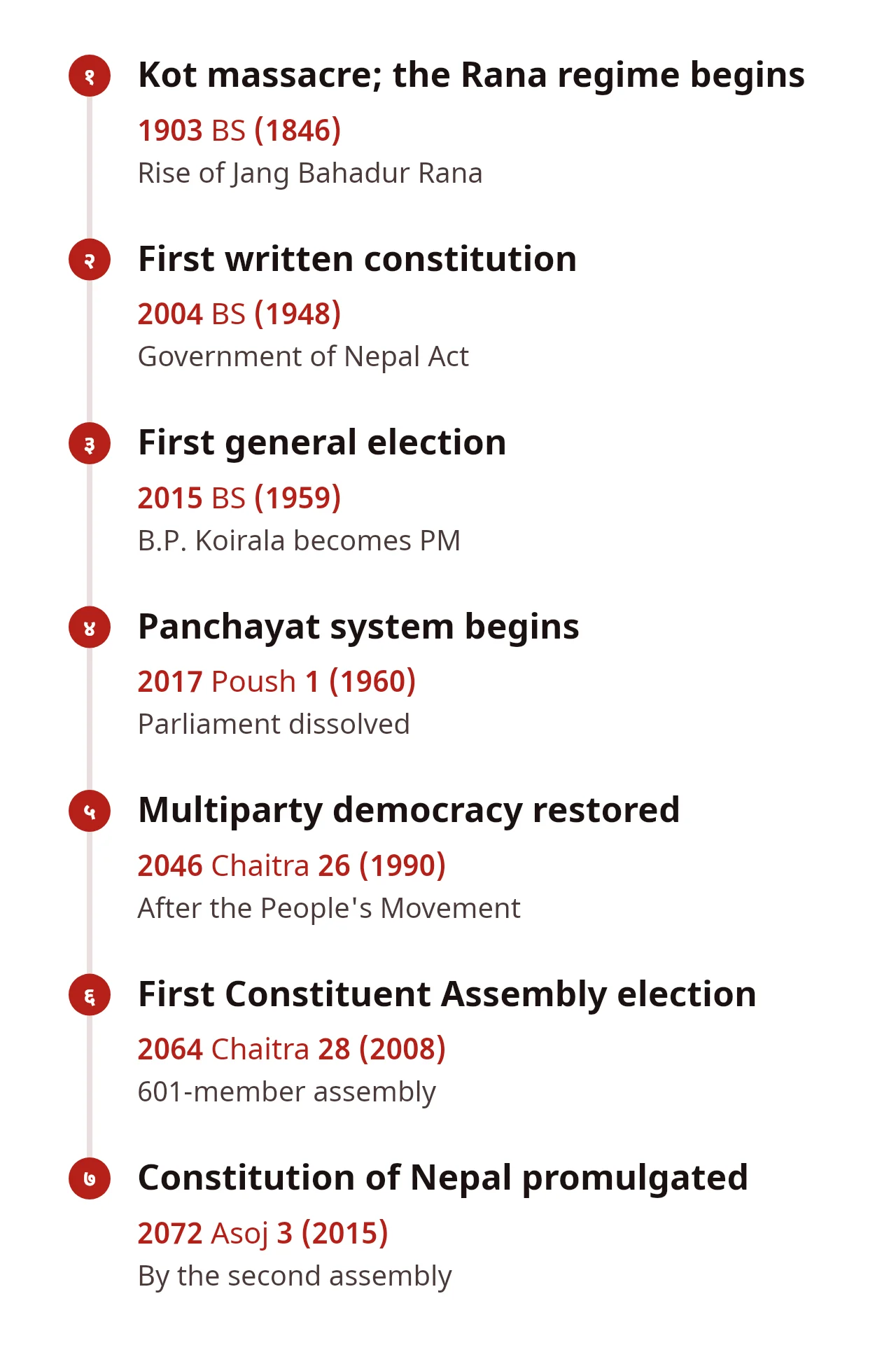
Prithvi Narayan Shah's campaign — Nuwakot (1801 BS), the Kirtipur battles, the conquest of Kantipur in 1825 BS (1768 AD) — opens modern history. After him: the Anglo-Nepal war (1814-16) and the Sugauli Treaty (1816), then the Kot massacre of 1903 BS (1846) that began 104 years of Rana rule. Exam favourites inside the Rana century: Jang Bahadur's Muluki Ain (1910 BS), Chandra Shamsher's abolition of sati and slavery, and the first school and college.
Democracy to republic
The timeline figure above is the single highest-yield table in this unit: 2007 (democracy), 2017 (Panchayat), 2046 (restoration), 2052-2062 (conflict years), 2062/63 (People's Movement II), 2065 (republic declared), 2072 (constitution). Learn it forwards and backwards; questions ask "which came first" as often as "when".
World history: the seven set topics
The Nasu syllabus names a short world list — the Renaissance, the industrial revolution, the American and French revolutions, the two world wars, the United Nations and major contemporary changes. One paragraph of facts per topic (dates, one cause, one result) is enough for the one or two questions asked.
How to study history
- Draw timelines, never lists: one for ancient/medieval, one for modern.
- Always carry both calendars: write 2046/1990 together.
- Connect history to the constitution unit — the 2072 constitution closes both stories; our constitution guide pairs well with this one.
- Drill MCQs weekly in the free practice sets and the history question bank — the AI practice resurfaces the dates you confuse.
Common mistakes
Learning only AD or only BS dates; memorising kings without their one defining act; and ignoring the world-history topics because they feel optional — they are set in the syllabus and the questions are easy marks.
Next, put the dates to work in the GK strategy guide or the overall preparation plan.
Frequently asked questions
How many history questions come in Kharidar and Nasu?
Kharidar's first paper draws six questions from its history unit; Nasu's first paper asks three from the history of Nepal and the world.
What was Nepal's first written constitution?
The Government of Nepal Act (Nepal Sarkar Baidhanik Kanun), 2004 BS (1948 AD), issued during the Rana period.
When was the first Constituent Assembly election held?
On Chaitra 28, 2064 BS (10 April 2008). The assembly's first meeting on Jestha 15, 2065 declared Nepal a federal democratic republic.
Sources
- Kharidar or equivalent syllabus: history (PDF, Nepali), Public Service Commission (2024-07-25)
- Nayab Subba or equivalent syllabus: history of Nepal and the world (PDF, Nepali), Public Service Commission (2024-07-25)
Courses for this topic
Kharidar General Knowledge (GK): Paper I
The 60-mark GK part of the Kharidar first paper: all five units with video, notes and MCQ practice.
Nayab Subba General Knowledge (GK): Paper I
The 60-mark GK part of the Nasu first paper, with video, notes and MCQ practice.
Kharidar + Nayab Subba First Paper Combo
Sitting both exams after +2? Screening preparation for both at one price.

Study in the Dipa App
Buy courses, join Live Classes and practise every day in the app. Payment works inside the app with eSewa.

Author
Dipa Academy editorial team
Dipa Academy's editorial team writes Lok Sewa guides from the Public Service Commission's official syllabus, notices and results, and cites every source.
Read next
Geography of Nepal for Loksewa: Facts the Exam Asks
21 November 2026 (मंसिर ५, २०८३)Current Affairs for Loksewa: a 20-Minute Daily Method
21 November 2026 (मंसिर ५, २०८३)Constitution of Nepal for Loksewa: Parts, Articles, Facts
21 November 2026 (मंसिर ५, २०८३)