How to Prepare for Loksewa: A 6-Month Plan from Zero
A direct answer to how to prepare for Loksewa: choosing a post, a six-month plan stage by stage, the first week day by day, what to read, how to measure progress, a daily timetable and the mistakes to avoid.
Once you decide to sit the Public Service Commission exams, the first question is: where do I start? Between piles of books, YouTube videos and friends' advice, many people spend their first two months confused. This guide gives a direct answer to how to prepare for Loksewa: from choosing a post to a six-month plan stage by stage, a daily timetable, how to practise and how to avoid common mistakes.
The exam facts here (number of questions, marks, time) come from the PSC's Kharidar syllabus and Nayab Subba syllabus, in force since FY 2081/82.
Step one: which post are you preparing for?
Beginners usually choose Kharidar (खरिदार, non-gazetted second class) or Nayab Subba (Nasu, नायब सुब्बा, non-gazetted first class). Both have three stages: a 50-question screening in Stage I, two written papers in Stage II, and a computer skill test and interview in the final stage.
Both first papers have 30 general knowledge questions. Kharidar takes its other 20 questions from the Basic Office Skills Test (BOST) and Nayab Subba from the General Mental Ability test (IQ). So if you qualify, you can prepare for both exams together. The minimum qualification and age limit are written in every advertisement; check them before you apply.
How to prepare for Loksewa: the six-month plan
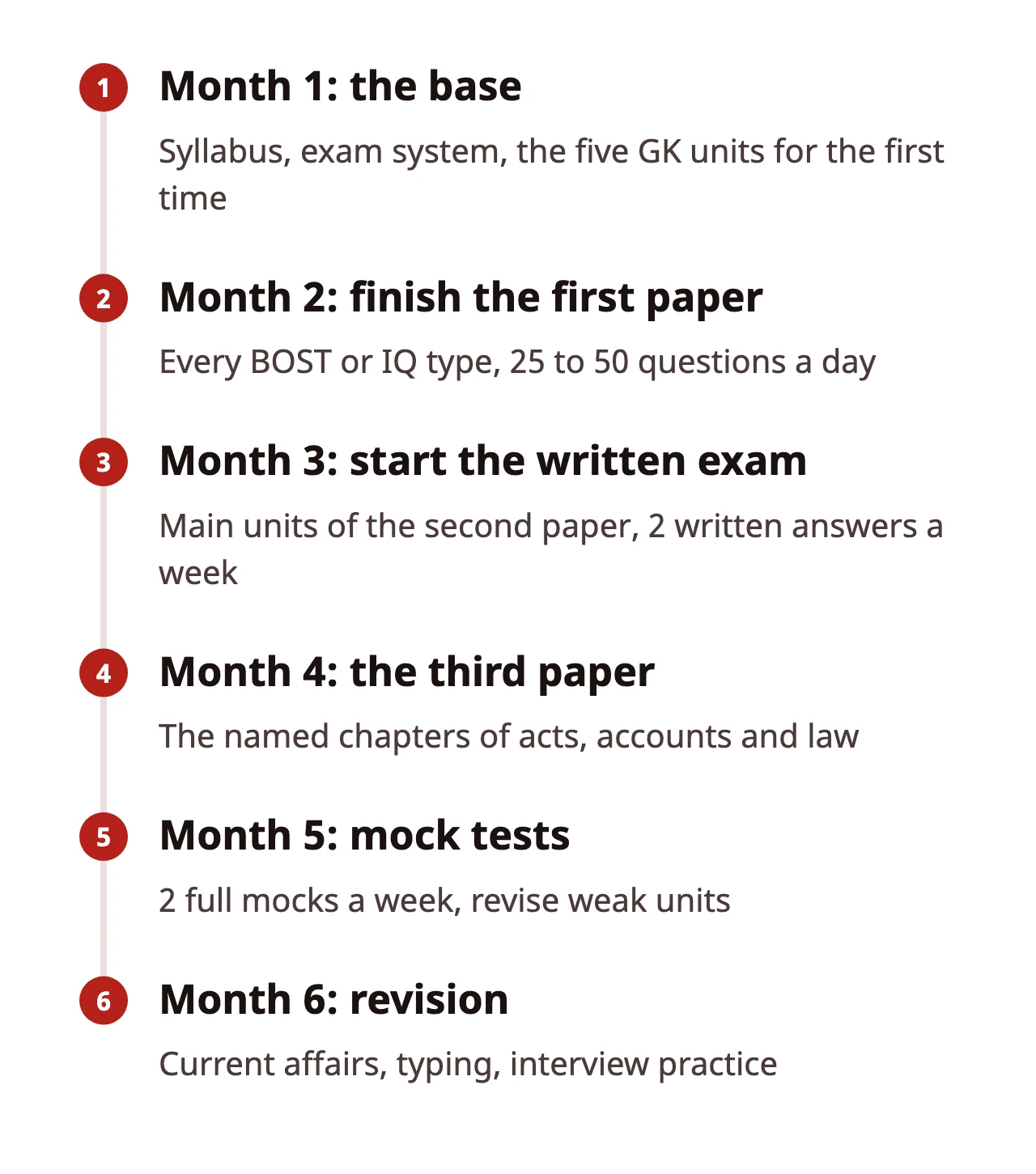
Month 1: build the base
In the first week, only understand the syllabus and exam system: the Kharidar exam pattern and the Nayab Subba exam pattern. Print the syllabus and keep it on your table; it is your reading list. In the other three weeks, read every general knowledge unit once, quickly, not in depth.
Month 2: finish the first paper
This month belongs to the first paper. Read one GK unit a day and practise 25 questions on it in the evening. Learn every type of BOST or IQ question; these get faster with practice, not memorising. In detail: our BOST loksewa guide and Lok Sewa IQ questions guide.
Month 3: start the written exam
The time between the Stage I result and Stage II is short, so start your written preparation now. The Kharidar second paper has office management, the constitution and general maths; the Nayab Subba second paper has contemporary studies and public service management. Write at least two answers by hand every week.
Month 4: the third paper
The Kharidar third paper (Job Knowledge) and the Nayab Subba service-group third paper name many chapters of acts and rules. Read only the chapters the syllabus names, not whole acts, and note the main sections in a short table.
Month 5: mock tests and fixing weak spots
Sit a full 50-question mock test in 45 minutes twice a week. List the questions you got wrong and read those units again. For the written papers, write a whole paper in the set time.
Month 6: revision and the final stage
Revise current affairs, raise your Nepali and English typing speed, and practise common interview questions. In detail: our Loksewa computer test guide and Nepali typing speed guide.
The first week, day by day
The first week is when habits form. This week, building the right pattern matters more than reading a lot.
- Day 1: download and print the Commission's syllabus. Note the sections and marks of the first, second and third papers on one page.
- Day 2: do 25 timed questions from a free practice set. Write down your score, whatever it is; this is your starting level.
- Day 3: skim the first GK unit (geography) and practise 15 questions.
- Day 4: the history unit, then learn two types of BOST or IQ questions.
- Day 5: society, economy and governance; the main parts and articles of the constitution on one page.
- Day 6: science, health and environment, plus a week of current affairs.
- Day 7: revise the week and take another 25-question test. Compare it with your day 2 score.
By the end of this week you will have the full picture of the syllabus and know your weak spots. From the next week, go into depth following the month 1 plan.
What to read, and where from?
Collecting too many sources scatters your study. Keep one main source and one practice source for each subject.
- Exam facts: the Commission's syllabus, advertisements and notices; treat these as final.
- The constitution and laws: the official text of the Constitution of Nepal and of the acts the syllabus names (the Nepal Law Commission website).
- Economic data: the Ministry of Finance's economic survey and budget speech, and Nepal Rastra Bank reports.
- Current affairs: reliable news sources and government notices; we publish them in our daily and weekly summaries with source links.
If a book and an official source disagree, go with the official source; data and laws change often.
How to measure progress
Every Sunday, sit one 50-question mock test in 45 minutes and write down three numbers: right, wrong and skipped. Check whether your score after negative marking is rising week by week. If it does not rise for two weeks, it is time to change how you study: cut down on new reading and practise the units you got wrong. For the written papers, track how many answers you wrote each week and whether you finished in the set time.
In the Dipa App, AI shows your strong and weak subjects and your "distance to success" from your tests, which makes planning the week easier; see AI Lok Sewa preparation.
How to build a daily timetable
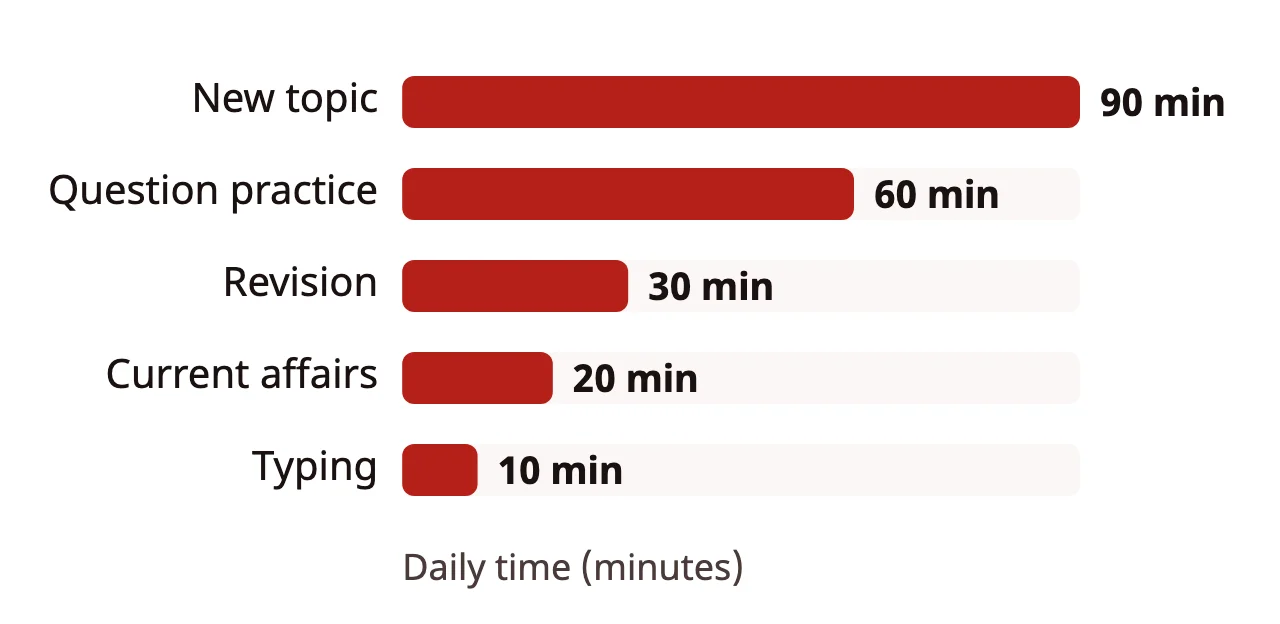
A timetable is built on regularity, not on long hours. Three and a half hours a day can be split like this: 90 minutes on a new topic, 60 minutes of question practice, 30 minutes revising earlier days, 20 minutes of current affairs and 10 minutes of typing.
How to practise
- Against the clock: the first paper gives you only 54 seconds per question on average. Practise with a watch.
- A note on every wrong answer: for each wrong answer, write one line on why it was wrong; before the exam, this note helps most.
- Negative marking: 20 percent of the marks are deducted for a wrong answer. When to guess is explained in our negative marking loksewa guide.
- Free practice: this website has practice sets (in Nepali) with answers and explanations.
General knowledge and current affairs
In general knowledge, studying by the syllabus units keeps you from wasting time on useless facts. Current affairs questions are new every year, so read current affairs (in Nepali) for 15 to 20 minutes a day.
The three stages: what comes when?
Before you make a plan, understand the whole path of the exam once. Kharidar and Nayab Subba both have three stages:
- Stage I (screening): 50 multiple-choice questions, 2 marks each, 45 minutes, pass mark 45. A wrong answer costs 0.4 marks. These marks are not added to the final result, but they open the door to the written exam. Kharidar has GK and BOST; Nasu has GK and IQ.
- Stage II (written, main exam): two subjective papers of 100 marks each, 2 hours 30 minutes, pass mark 40.
- Final stage: a 10-mark computer skill test and a 30-mark interview.
The final result comes from the total of the main exam and the final stage. The pass mark of every paper is listed in our Lok Sewa pass mark guide.
How much competition is there?
According to the Commission's 67th annual report, 382,947 applications were made in FY 2082/83, about 250 applications per post. That means reaching the pass mark is not enough; you need more marks than others to be selected. But there is no need to fear: not everyone who applies has prepared regularly, and planned preparation is what makes the difference. The key figures of the report are in our summary of the 67th annual report (in Nepali).
If you prepare for Kharidar and Nasu together
Under the Commission's annual schedule, the Nayab Subba advertisement comes out on the last Wednesday of Mangsir and the Kharidar advertisement on the last Wednesday of Poush. Because the general knowledge of both first papers overlaps a lot, preparing together is easy. The differences: BOST in Kharidar, IQ in Nasu, and different written papers. So spend the first two months on shared GK, then practise both BOST and IQ, and in the written exam put the papers of your main target first. Check your age and qualification before you apply with our Loksewa age limit and online form guides.
When to start the written exam
Many people start the written preparation only after the first-paper result, then regret it when time runs out. The time between the first paper and the written exam can be short. So from the third month, give two days a week to the written papers: subjects such as the constitution, office management and the civil service also help in the first paper, so this time is not wasted.
Motivation and consistency
Lok Sewa preparation usually lasts months. Weeks when your score does not rise, tiredness and confusion are natural. Write every mock test score on one page; a three- or four-week line shows your progress. Take one evening a week fully off, and form a small group of friends who are preparing too.
Common mistakes
- Starting only after the advertisement. Under the PSC's annual schedule for FY 2083/84, the Nayab Subba advertisement is due on the last Wednesday of Mangsir, 9 December 2026 (मंसिर २३, २०८३), and the Kharidar one on the last Wednesday of Poush, 13 January 2027 (पुस २९, २०८३); after that there are only a few weeks to the exam.
- Many books, little practice. One reliable source and plenty of question practice beat many books.
- Thinking about the written exam later. Once you pass the first paper, time is short.
- Old-syllabus material. The syllabus changed from FY 2081/82; use old question collections only after checking them against it.
- Ignoring health and sleep. In six months of preparation, consistency is your biggest strength.
Take a class or study alone?
You can pass by studying alone. A class gives you a plan, regular practice and a place to ask questions. Dipa Academy has live classes every morning, notes by chapter, tests and AI-picked practice in the app; the full list is on what we offer. Try the free Lok Sewa Free Starter before you pay anything, and read the checklist in the best Lok Sewa class in Nepal.
Conclusion
Lok Sewa preparation is a long race: make the syllabus your map, start with the first paper, bring the written exam along with it, and measure your progress every week. Today, open the Kharidar or Nayab Subba page for the full details of your post and plan your first week.
Six steps to start Lok Sewa preparation
- Choose your post: Kharidar, Nayab Subba or both; check the qualification and age in the advertisement.
- Print the syllabus: Make the Commission's official syllabus your reading list.
- Start with the first paper: Give the first two months to general knowledge and BOST or IQ.
- Practise daily: Do timed practice questions every day.
- Bring in the written exam: Add the second and third papers from the third month.
- Mock tests and revision: A full mock test once a week and a list of wrong answers.
Frequently asked questions
How many months does Lok Sewa preparation take?
It depends on the person and the post. With three to four regular hours a day you can cover the whole first-paper syllabus once in two months; a six-month plan is practical for full preparation including the written exam.
Kharidar or Nayab Subba first?
Both first papers have 30 general knowledge questions. If you qualify, you can sit both exams, and studying GK once saves time. Check the qualification and age limit in each advertisement.
Can I pass Lok Sewa without coaching?
Yes, if you study regularly by the official syllabus and practise a lot. A class helps with planning, practice and feedback; start with free material and decide based on what you need.
Sources
- Kharidar or equivalent syllabus, from FY 2081/82 (PDF, Nepali), Public Service Commission (2024-07-25)
- Nayab Subba or equivalent syllabus, from FY 2081/82 (PDF, Nepali), Public Service Commission (2024-07-25)
- Annual recruitment schedule for FY 2083/084 (PDF, Nepali), Public Service Commission (2026-07-17)
Courses for this topic
Lok Sewa Free Starter: Where to Begin
Free for life: how the Kharidar and Nasu exams work, who can apply, the marks and a study plan.
Kharidar + Nayab Subba First Paper Combo
Sitting both exams after +2? Screening preparation for both at one price.
Lok Sewa Complete Combo: Kharidar and Nayab Subba
All 14 courses for both exams: one payment, one year, nothing left out.

Study in the Dipa App
Buy courses, join Live Classes and practise every day in the app. Payment works inside the app with eSewa.

Author
Dipa Academy editorial team
Dipa Academy's editorial team writes Lok Sewa guides from the Public Service Commission's official syllabus, notices and results, and cites every source.
Read next
Top 10 Loksewa Institutes in Nepal (2026): How to Choose
21 November 2026 (मंसिर ५, २०८३)Loksewa GK Strategy: 60 Marks of General Knowledge
21 November 2026 (मंसिर ५, २०८३)Loksewa Preparation With a Job: a Two-Hour Daily Plan
21 November 2026 (मंसिर ५, २०८३)