
Loksewa GK Strategy: 60 Marks of General Knowledge
Both first papers carry 30 GK questions worth 60 marks. The unit weights for Kharidar and Nasu, Level I vs Level II question styles, what to study and what to skip, the four-step cycle and how to turn mock tests into marks.
A working loksewa GK strategy starts from one number: GK is worth 60 of the first paper's 100 marks in both Kharidar and Nayab Subba — 30 questions at 2 marks each. The candidates who clear the pass mark of 45 almost always do it on the back of GK, because the IQ and BOST sections are harder to raise quickly.
Study the weights, not the ocean
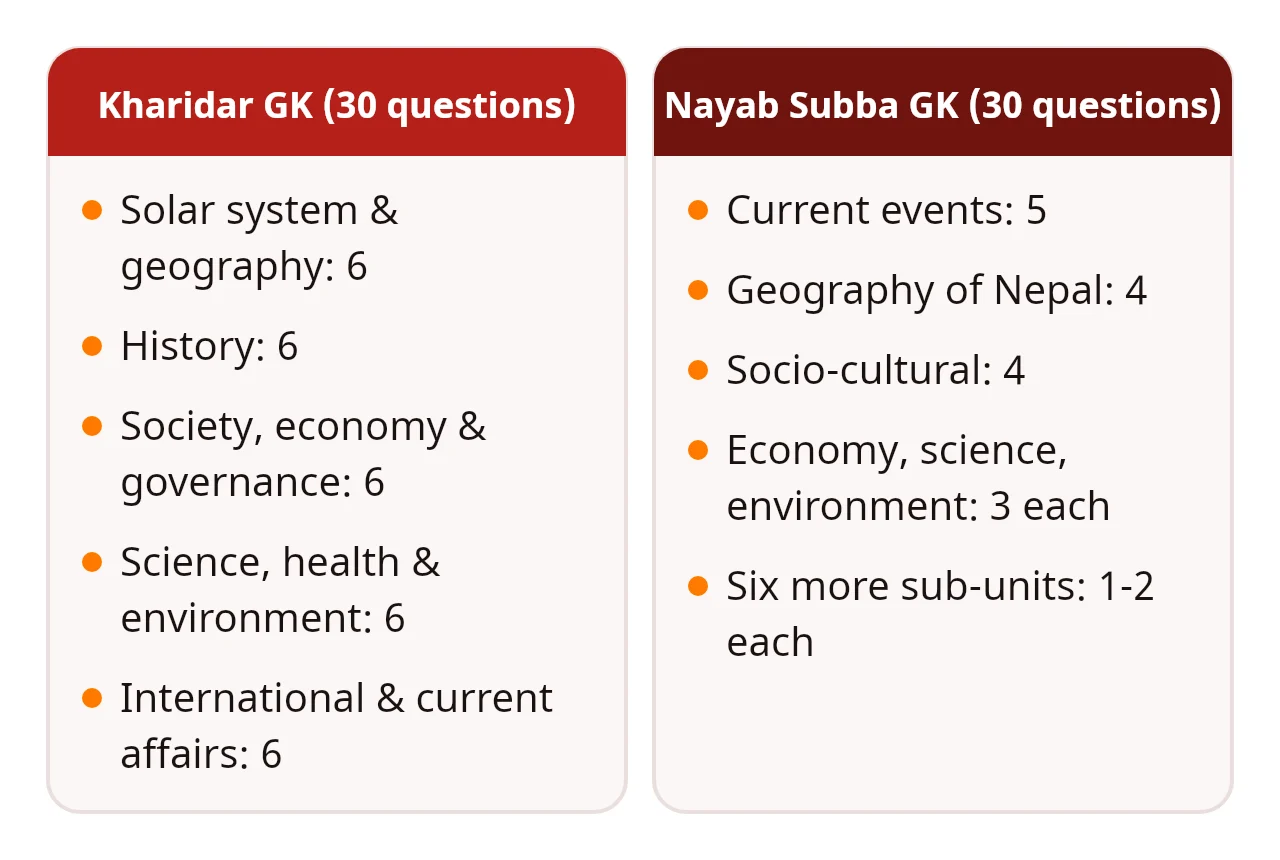
The syllabus fixes how many questions each unit gives, so your hours should follow the weights in the figure above. For Kharidar: five units, six questions each — equal time. For Nasu: current affairs and geography first, socio-cultural and economy next, and the one-question sub-units last. An hour on a six-question unit is worth six times an hour on a one-question unit.
Level I and Level II formats
Half the battle is format familiarity. Level I items are straight four-option questions. Level II items use the same facts in harder clothes: true/false combinations, matching lists, chronological ordering. The fix is not more reading — it is practising each format until the twist stops costing time. The question banks tag both levels, and the free practice sets include samples.
What to study, unit by unit
- Geography: the tables in our geography guide — position, regions, rivers, provinces.
- History: the timelines in the history guide — dates in both calendars.
- Society, economy and governance: the constitution's structures (constitution guide), current budget headline numbers, main social indicators.
- Science, health and environment: everyday applications, national parks and climate basics; depth is not asked.
- International and current affairs: the 20-minute daily method plus the permanent organisations table.
The four-step cycle
- Read one sub-unit (45 minutes, notes in tables).
- Drill 20 MCQs on it the same day.
- Re-drill the wrong ones after three days.
- Mix it into a weekly 50-question mixed test.
The AI practice in the Dipa App runs steps 2-4 automatically, biasing towards your weak units and showing the gap to the pass mark on your progress screen.
Mock tests are the multiplier
A weekly timed mock with honest negative marking (0.4 per wrong answer — the calculator helps) tells you three things reading never will: your real speed, your guess discipline, and which units leak marks. Review wrong answers the same day; that half hour is where ranks change.
Preparing for both exams?
The overlap is big enough that one GK base serves both: study to the Nasu sub-unit depth, then add the Kharidar BOST unit separately (BOST guide). Sit both exams; the first one becomes a paid mock for the second.
Common mistakes
Reading GK books cover to cover without the syllabus open; ignoring Level II formats until the exam; endless current-affairs collection with zero quizzing; and skipping mocks. Weight-driven reading plus relentless MCQ cycling is the entire strategy.
Frequently asked questions
How many GK questions come in Lok Sewa?
Both the Kharidar and Nayab Subba first papers ask 30 GK questions at 2 marks each: 60 of the paper's 100 marks. The remaining 20 questions test IQ (Nasu) or office skills (Kharidar BOST).
What are Level I and Level II questions?
Level I items are plain four-option MCQs. Level II items still have four options but twist the format: true/false sets, matching pairs, ordering and best-answer items. The syllabus fixes how many of each come from every unit.
Is Kharidar GK the same as Nasu GK?
They overlap heavily but are weighted differently. Kharidar draws six questions from each of five units; Nasu spreads 30 questions across eleven sub-units, with current affairs (5) and geography (4) the heaviest.
Sources
- Kharidar or equivalent syllabus (PDF, Nepali), Public Service Commission (2024-07-25)
- Nayab Subba or equivalent syllabus (PDF, Nepali), Public Service Commission (2024-07-25)
Courses for this topic
Kharidar General Knowledge (GK): Paper I
The 60-mark GK part of the Kharidar first paper: all five units with video, notes and MCQ practice.
Nayab Subba General Knowledge (GK): Paper I
The 60-mark GK part of the Nasu first paper, with video, notes and MCQ practice.
Kharidar + Nayab Subba First Paper Combo
Sitting both exams after +2? Screening preparation for both at one price.

Study in the Dipa App
Buy courses, join Live Classes and practise every day in the app. Payment works inside the app with eSewa.

Author
Dipa Academy editorial team
Dipa Academy's editorial team writes Lok Sewa guides from the Public Service Commission's official syllabus, notices and results, and cites every source.
Read next
Top 10 Loksewa Institutes in Nepal (2026): How to Choose
21 November 2026 (मंसिर ५, २०८३)Loksewa Preparation With a Job: a Two-Hour Daily Plan
21 November 2026 (मंसिर ५, २०८३)Negative Marking in Loksewa: When to Guess and When to Skip
11 November 2026 (कात्तिक २५, २०८३)