Loksewa Preparation With a Job: a Two-Hour Daily Plan
How to prepare for Kharidar and Nayab Subba alongside a job, business or college: the two-hour weekday timetable, commute and lunch-break study, weekend mock tests, fatigue management and keeping office and family on side.
Loksewa preparation with a job is not about finding more hours — it is about making two hours count every single day. Most candidates who pass Kharidar or Nayab Subba while working follow the same shape of week: short, fixed weekday blocks, one honest weekend mock test, and recordings instead of missed classes.
Start with honest arithmetic
A working week gives you roughly 10 weekday hours (2 × 5) plus 6-8 weekend hours: about 16-18 study hours a week, or 65-75 a month. That is genuinely enough for the first paper in three to four months — but only if the hours repeat every week. Write your real number down before planning anything else.
The weekday pattern
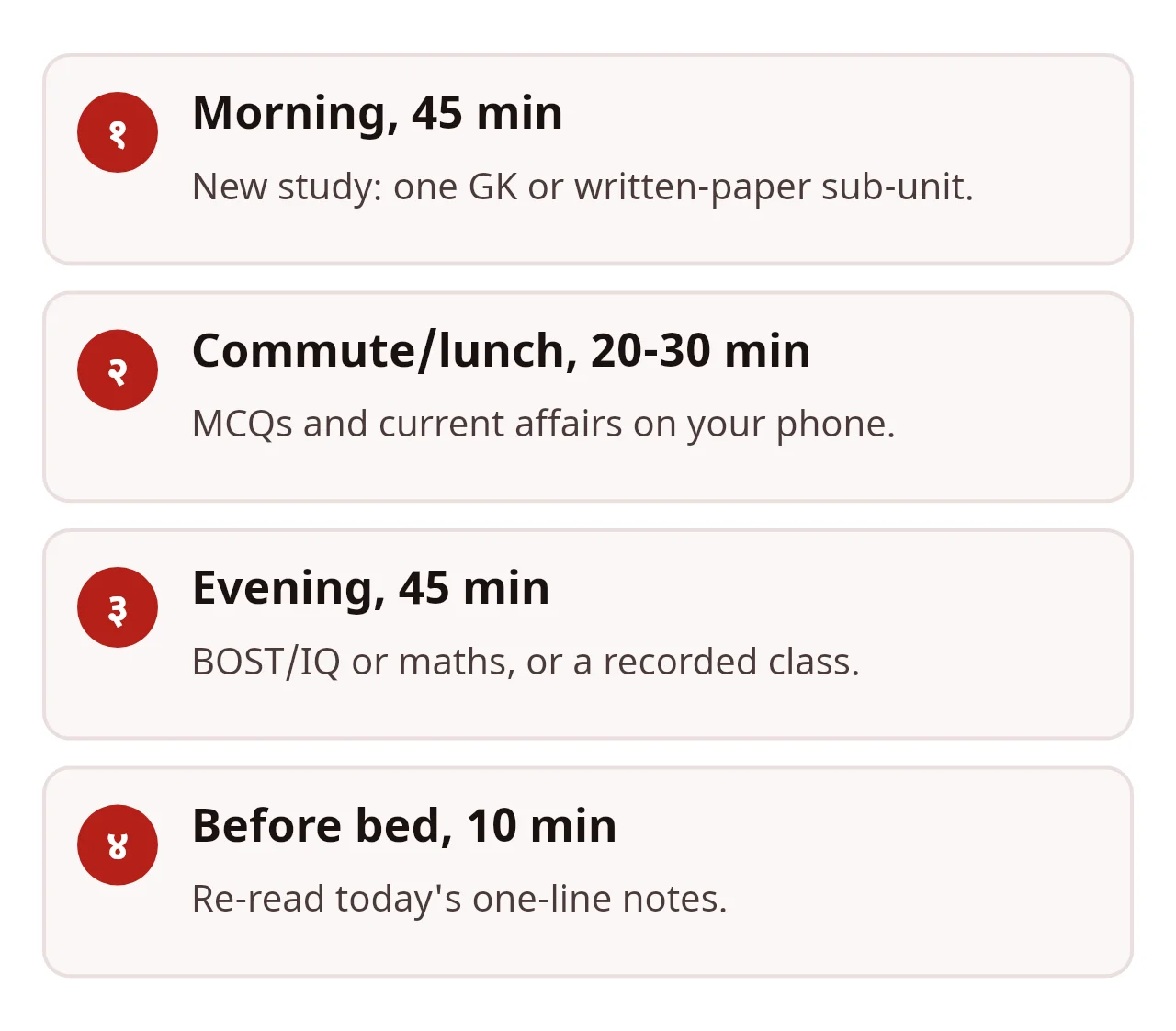
Morning fresh time goes to new study (one sub-unit of GK or a written-paper section). The commute and lunch break go to your phone: ten MCQs and the day's current-affairs summary. The evening block goes to practice-heavy subjects — IQ, maths, BOST — or a recorded class. The ten minutes before bed, re-reading today's one-line notes, is what makes the rest stick.
The weekend pattern
One weekend half-day carries the two things weekdays cannot: a full timed mock test and the week's revision. Mark the mock honestly with negative marking (the calculator does the arithmetic) and spend thirty minutes on the wrong answers — that half hour is the highest-yield study of the week.
Missed classes and recordings
Never trade office hours for live classes; trade evenings for recordings instead. At Dipa every live class is recorded and attached to the course automatically, so a 10 a.m. class becomes an 8 p.m. class with a pause button. One account works on your phone and your computer, so the office lunch break and the home desk both count.
Fatigue and consistency
Tired days happen. The rule that protects the habit: on a bad day, do the minimum unit — ten MCQs and the notes re-read, fifteen minutes — rather than zero. Streaks survive on minimum units; plans die on skipped days. The daily questions in the Dipa App exist exactly for this.
How long does it take?
With 16-18 real hours a week: roughly 3-4 months to be first-paper ready, and a further 2-3 months for the written papers, depending on your base. Starting when the annual timetable is published, not when the advertisement drops, is what makes the deadline comfortable — see the exam countdown.
Your office experience is an asset
Serving candidates walk into the written papers and the interview with real examples of office procedure, filing and public service delivery. Use your workplace vocabulary in the second and third papers; examiners reward concreteness. And under the Civil Service Act, serving civil servants face no upper age limit for internal advancement paths — check your advertisement's terms.
Common mistakes
Planning eight-hour weekends that never happen; studying only on the phone and never writing an answer by hand; skipping mocks because "the syllabus is not finished". The syllabus is never finished — the mock is the syllabus check.
Pick your two hours, set them in the 30-day plan format, and start tonight.
Frequently asked questions
Can I pass Lok Sewa while working?
Yes. Consistency decides it: about two focused hours on workdays and a longer weekend session with a mock test outperform irregular bursts. Thousands of serving employees pass every cycle.
How many hours a day do I need?
There is no fixed rule, but two hours on workdays and around four on weekends is sustainable for most working candidates. Studying eight hours one day and zero the next is the pattern that fails.
What if the live class runs during office hours?
At Dipa Academy every live class recording is added to the course automatically, so you can watch in the evening or on your day off and replay it as often as you need.
Sources
- Kharidar or equivalent syllabus (PDF, Nepali), Public Service Commission (2024-07-25)
Courses for this topic
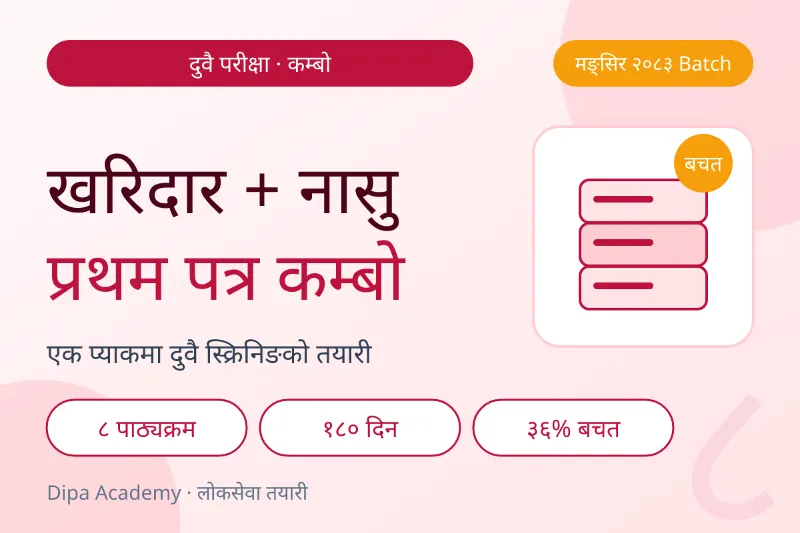
Kharidar + Nayab Subba First Paper Combo
Sitting both exams after +2? Screening preparation for both at one price.
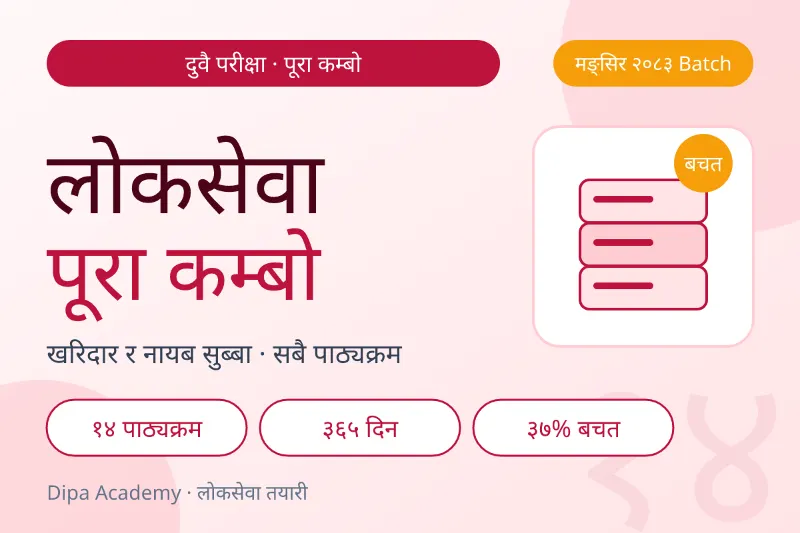
Lok Sewa Complete Combo: Kharidar and Nayab Subba
All 14 courses for both exams: one payment, one year, nothing left out.
Lok Sewa Free Starter: Where to Begin
Free for life: how the Kharidar and Nasu exams work, who can apply, the marks and a study plan.

Study in the Dipa App
Buy courses, join Live Classes and practise every day in the app. Payment works inside the app with eSewa.

Author
Dipa Academy editorial team
Dipa Academy's editorial team writes Lok Sewa guides from the Public Service Commission's official syllabus, notices and results, and cites every source.
Read next
Top 10 Loksewa Institutes in Nepal (2026): How to Choose
21 November 2026 (मंसिर ५, २०८३)Loksewa GK Strategy: 60 Marks of General Knowledge
21 November 2026 (मंसिर ५, २०८३)Negative Marking in Loksewa: When to Guess and When to Skip
11 November 2026 (कात्तिक २५, २०८३)