Nasu Pass Mark and Kharidar Pass Mark: Every Lok Sewa Paper Explained
The pass mark of every Kharidar and Nayab Subba (Nasu) paper from the PSC syllabus, which marks count for the final result, how negative marking affects passing, why the pass mark is not the cut-off, and what score to aim for.
"What is the Nasu pass mark?" is one of the most searched Lok Sewa questions, usually followed by the same question for Kharidar. The answer is short: 45 out of 100 in the first paper and 40 out of 100 in each written paper. But the pass mark alone does not tell you whether you will be selected, and it does not tell you which marks decide your final rank. This guide gives the pass mark of every paper of Kharidar (खरिदार) and Nayab Subba (Nasu, नायब सुब्बा) from the Public Service Commission's syllabus, then explains what it means for your preparation.
Nasu pass mark and Kharidar pass mark for every paper
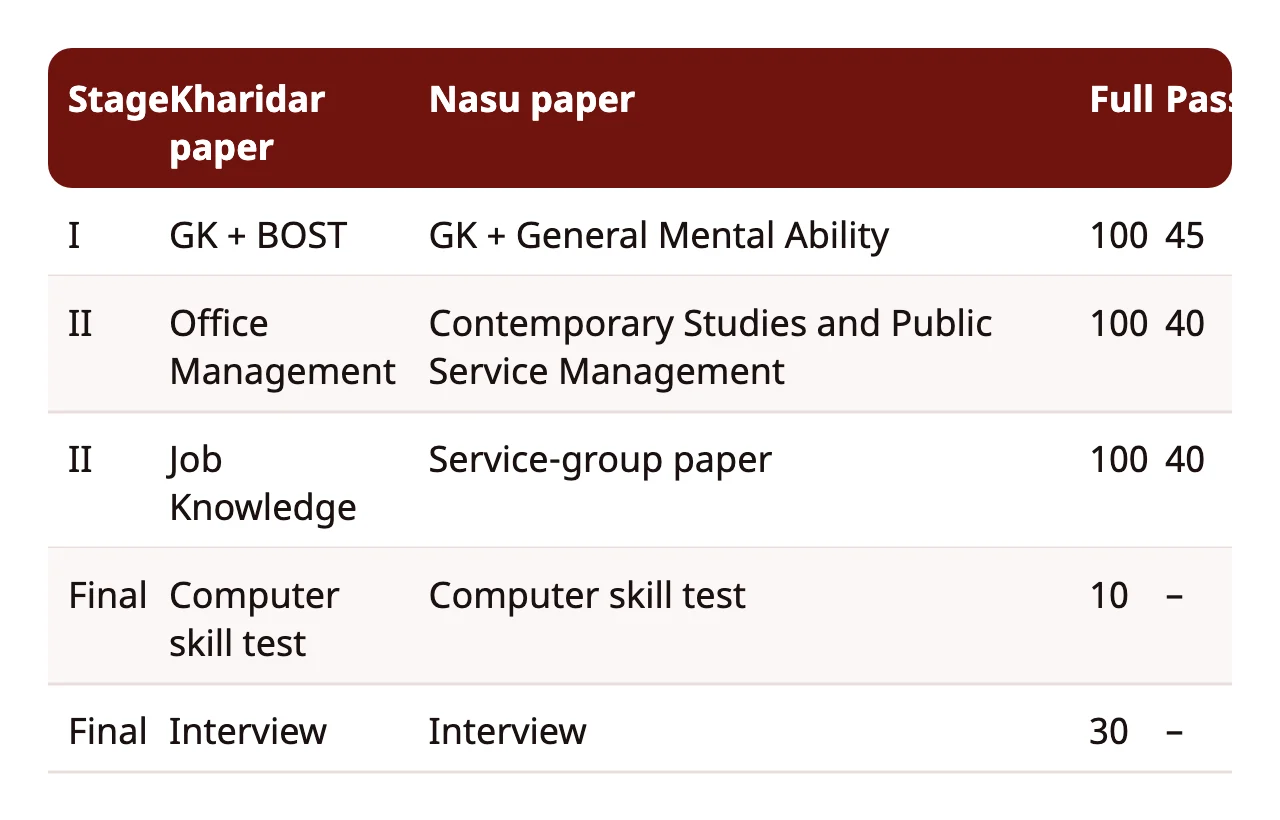
The PSC's Kharidar syllabus and Nayab Subba syllabus, in force since the FY 2081/82 advertisements, set the same pass marks for both posts:
- Stage I, the first paper: 45 out of 100. It has 50 multiple-choice questions of 2 marks each in 45 minutes.
- Stage II, the second paper: 40 out of 100, subjective, 2 hours 30 minutes.
- Stage II, the third paper: 40 out of 100, subjective, 2 hours 30 minutes.
- Final stage: the computer skill test (10 marks) and the interview (30 marks) have no pass mark in the syllabus table.
You must pass each written paper separately. A high score in one paper does not make up for a fail in the other.
Which marks count for the final result?
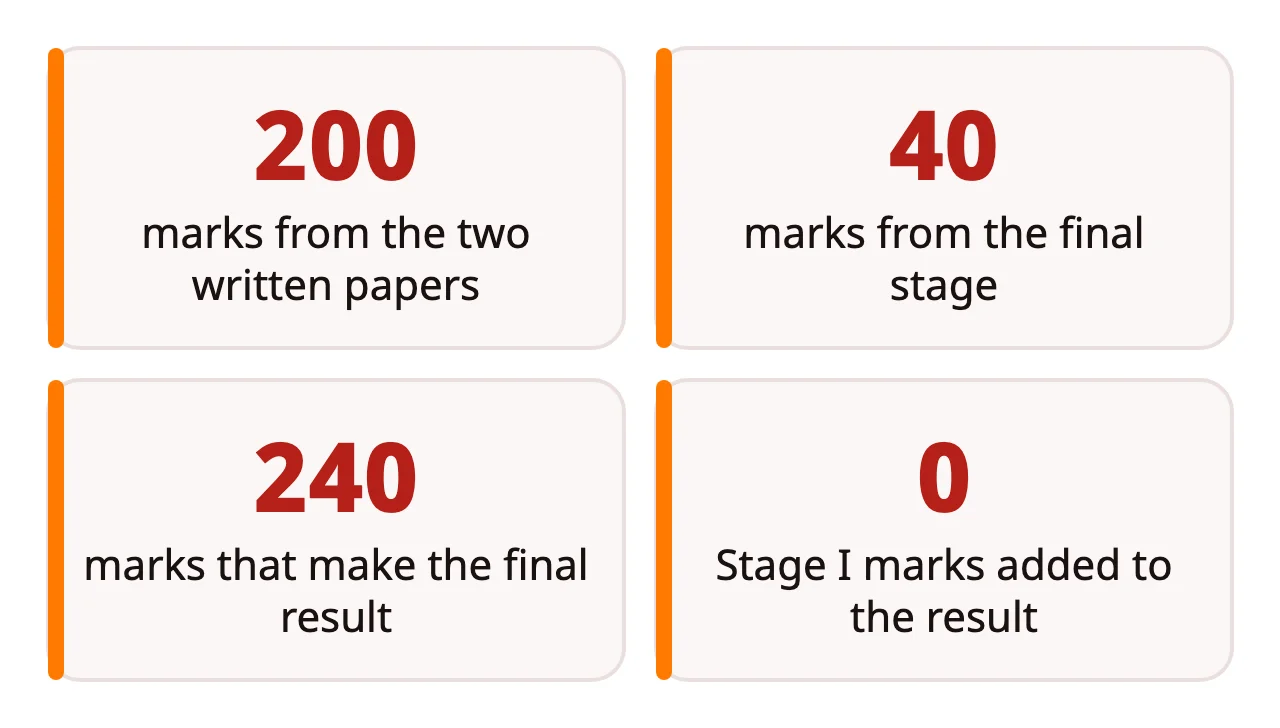
The first paper is a screening exam. Its marks decide who sits the written exam, but they are not added to the final result. The final result is worked out from the written exam (200 marks) and the final stage (40 marks), 240 marks in all.
This changes how you should plan. Two candidates who score 80 and 60 in the first paper start the written exam equal. What separates them is the second and third papers, where one 10-mark answer is worth as much as the whole computer test, and then the interview.
How negative marking affects the first-paper pass mark
In the first paper, 20 percent of a question's marks are deducted for every wrong answer: 0.4 marks on a 2-mark question. A blank costs nothing. So your score is right answers × 2 − wrong answers × 0.4.
Some examples on the 50-question paper:
| Right | Wrong | Skipped | Marks | Pass? |
|---|---|---|---|---|
| 25 | 5 | 20 | 48 | Yes |
| 24 | 6 | 20 | 45.6 | Yes, just |
| 23 | 10 | 17 | 42 | No |
| 30 | 15 | 5 | 54 | Yes |
The third row shows the danger of guessing: 23 right answers would give 46 on their own, but 10 wrong answers take away 4 marks and the candidate fails. Our negative marking loksewa guide explains when a guess pays, and the negative marking calculator does the sum for you.
The pass mark is not the cut-off
Passing the first paper is not the same as being selected. How many candidates go on to the written exam depends on how many applied and how they scored. Recent PSC results for organised institutions show the scale: in the pre-qualifying exam for Nayab Subba-level posts (advertisement 101/083-84), 18,216 of 69,803 candidates were selected for the second stage, about 26 percent; in the Kharidar-level exam (advertisement 102/083-84), 26,063 of 74,473, about 35 percent. The details are on our notice pages (in Nepali): Nasu-level result and Kharidar-level result.
With selection rates like these, scoring just 45 is risky. The PSC does not publish one fixed cut-off for every exam, so do not trust any single number you see online. Instead, set your own target with a margin.
What score should you aim for?
A practical target in mock tests is well above the pass mark:
- First paper: aim for 65 or more in timed mock tests. That is about 35 right and no more than 12 wrong out of 50. Exam nerves usually take a few marks off.
- Each written paper: aim for 55 or more in graded mock papers. Answering every question in the set time matters as much as knowledge; an unanswered 10-mark question is 10 marks lost.
- Final stage: typing is the easiest of these marks. 25 correct words per minute in Nepali and 30 in English earn the full 2.5 marks each; see our Nepali typing speed guide.
These are our suggestions for safe preparation, not official numbers.
Kharidar and Nasu: same pass marks, different papers
The pass marks match, but the papers do not. In the first paper, both have 30 general knowledge questions; Kharidar adds 20 Basic Office Skills Test (BOST) questions and Nasu adds 20 General Mental Ability (IQ) questions. In the written exam, Kharidar has Office Management and Job Knowledge (पदीय ज्ञान) for everyone, while Nasu has a common second paper and a third paper that depends on the service group. The full formats are on the Kharidar exam pattern and Nayab Subba exam pattern pages.
If you sit both exams, your first-paper preparation is mostly shared; practise BOST and IQ separately. Our guides to BOST and Lok Sewa IQ questions cover both.
How to cross the pass mark safely
- Learn the syllabus by weight. In the Nasu first paper, current events, Nepal's geography and social and cultural life give 13 of the 30 GK questions; the Nasu first paper syllabus lists every sub-unit.
- Practise against the clock. 54 seconds per question is the average in the first paper.
- Track right, wrong and skipped. After every mock test, write down all three and your score after negative marking.
- Start the written papers early. The pass mark of 40 in each written paper needs answer-writing practice, which takes weeks.
- Keep typing on the side. Ten minutes a day is enough to reach full marks by the final stage.
Pass marks and the age and form rules
Passing marks only matter if your application is valid. Before you apply, check how age is counted in our Loksewa age limit guide and follow the steps in the Loksewa online form guide.
Conclusion
The Nasu pass mark and the Kharidar pass mark are the same: 45 in the first paper and 40 in each written paper. But the first paper only opens the door, selection depends on competition, and the final rank comes from the 200 written marks and the 40 final-stage marks. Aim well above the pass mark in your mock tests, and give the written papers the time they need. The free Lok Sewa Free Starter course explains the marks of every paper in Nepali, and our how to prepare for Loksewa plan shows how to fit it all into six months.
Frequently asked questions
What is the Nasu pass mark?
45 out of 100 in the Stage I first paper, and 40 out of 100 in each of the two Stage II written papers. The computer test and interview have no separate pass mark in the syllabus table.
What is the Kharidar pass mark?
The same as Nasu: 45 out of 100 in the Stage I first paper and 40 out of 100 in each written paper (Office Management and Job Knowledge).
Is passing Stage I enough to reach the written exam?
Not always. Stage I is a screening exam, and how many candidates go on depends on competition, so the score you need can be well above 45.
Sources
- Kharidar or equivalent syllabus: exam plan, Stage I and Stage II (PDF, Nepali), Public Service Commission (2024-07-25)
- Nayab Subba or equivalent syllabus: exam plan, Stage I and Stage II (PDF, Nepali), Public Service Commission (2024-07-25)
- Result of the Nayab Subba-level pre-qualifying exam of organised institutions, advertisement 101/083-84 (PDF, Nepali), Public Service Commission (2026-10-11)
- Result of the Kharidar-level pre-qualifying exam of organised institutions, advertisement 102/083-84 (PDF, Nepali), Public Service Commission (2026-10-29)
Courses for this topic
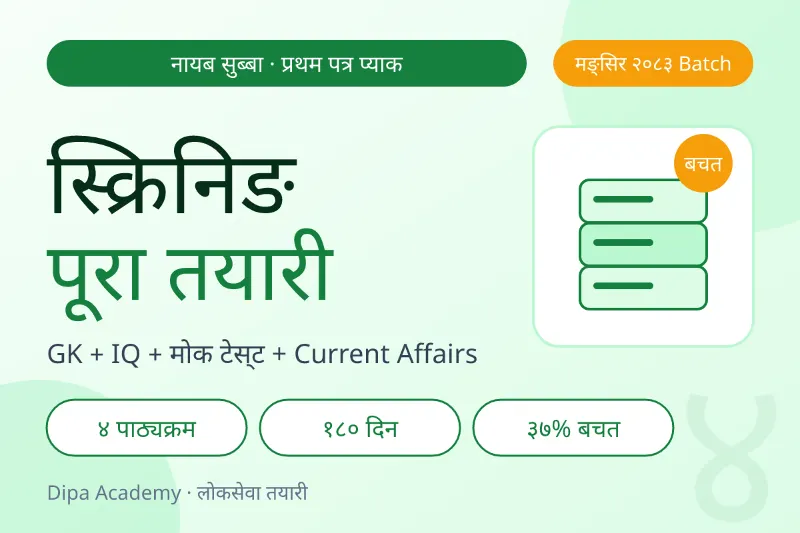
Nayab Subba First Paper Pack: GK + IQ + Mock Tests
GK, IQ (GMAT), mock tests and weekly current affairs for the Nasu screening, all in one place.
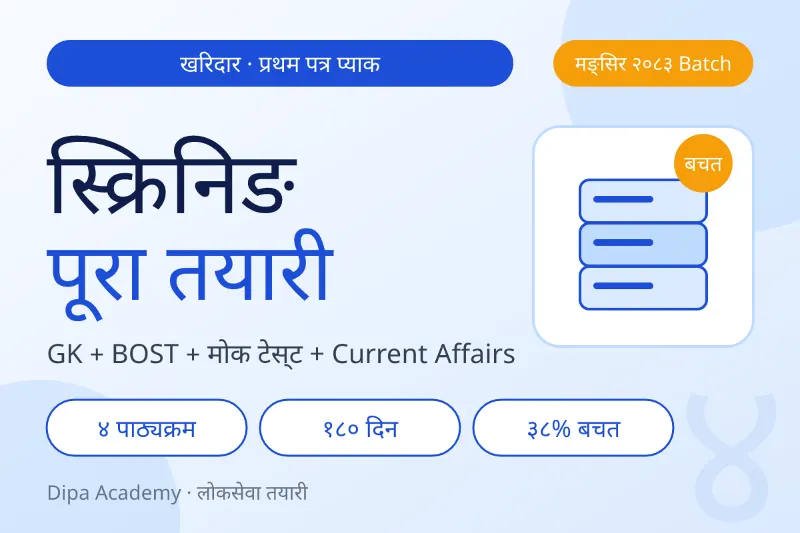
Kharidar First Paper Pack: Pass the Screening
GK, BOST, mock tests and weekly current affairs for the Kharidar screening, in one pack.
Nayab Subba First Paper Test Series (Mock Tests)
Old questions, full mock tests and GK and IQ practice sets for the Nasu first paper, marked like the exam.
Kharidar First Paper Test Series (Mock Tests)
Old questions, full mock tests and practice sets for the Kharidar first paper, marked like the real exam.

Study in the Dipa App
Buy courses, join Live Classes and practise every day in the app. Payment works inside the app with eSewa.

Author
Dipa Academy editorial team
Dipa Academy's editorial team writes Lok Sewa guides from the Public Service Commission's official syllabus, notices and results, and cites every source.
Read next
Nasu Third Paper: a Different Paper per Service Group
21 November 2026 (मंसिर ५, २०८३)Nasu Second Paper: Contemporary Studies and Public Service
21 November 2026 (मंसिर ५, २०८३)Kharidar Third Paper: the Acts, Accounts and Law to Study
21 November 2026 (मंसिर ५, २०८३)