
Constitution of Nepal for Loksewa: Parts, Articles, Facts
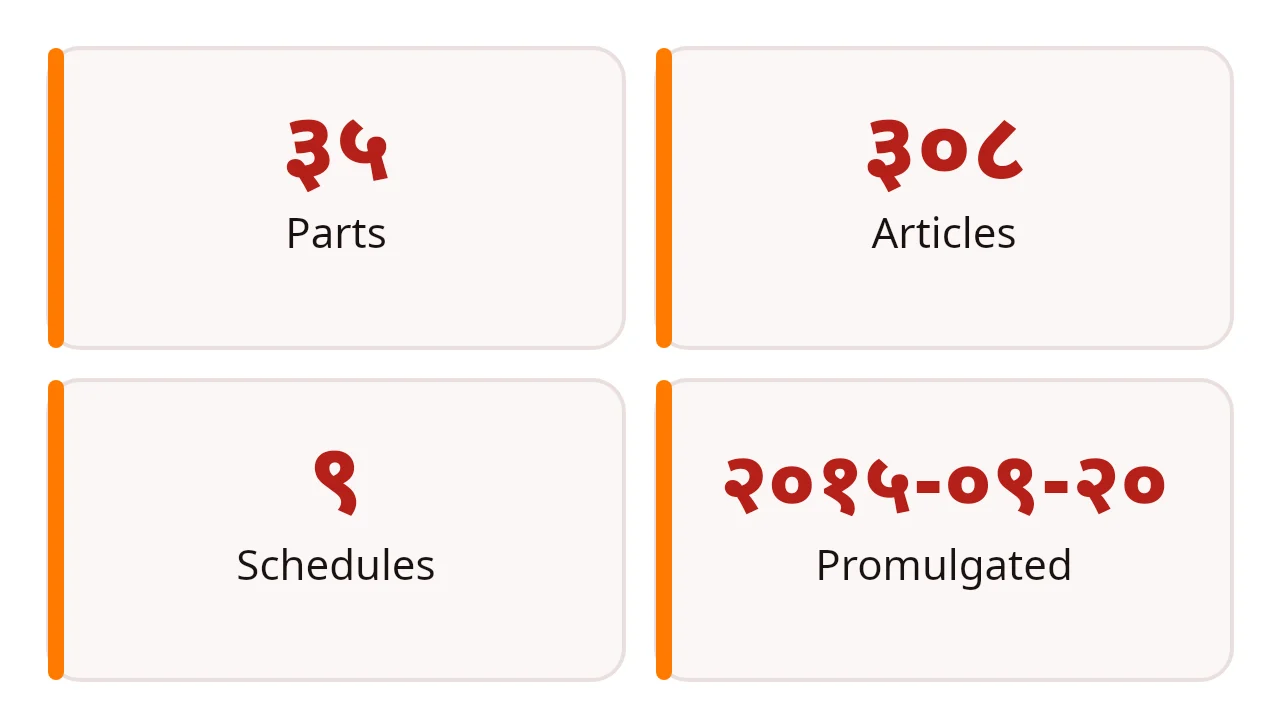
What the Constitution of Nepal contributes to the Kharidar and Nayab Subba exams: the structure (35 parts, 308 articles, 9 schedules), fundamental rights, the federal parliament, constitutional bodies, and a practical way to memorise articles.
The constitution of Nepal loksewa questions are among the most predictable marks in the whole exam: the facts never change between advertisements, and the same handful of structures comes up again and again. The constitution feeds the first paper's GK section in both Kharidar and Nayab Subba, a full section of the Kharidar second paper (constitution and civic awareness, 30 marks), a Nasu second-paper section, and many interview questions.
The structure you must know cold
The Constitution of Nepal was promulgated by the second Constituent Assembly on Asoj 3, 2072 BS (20 September 2015). It has 35 parts, 308 articles and 9 schedules. It declares Nepal a federal democratic republic with sovereignty in the people, and it is the seventh constitution in Nepal's constitutional history.
Early articles: the state defined
Articles 1 to 9 define the nation, the territory, the state language and the flag: the constitution as supreme law (article 1), sovereignty in the Nepali people (article 2), Nepali in Devanagari script as the official language (article 7), and the flag, anthem and other symbols with details in the schedules.
Part 3: fundamental rights
Articles 16 to 46 carry 31 fundamental rights, from the right to live with dignity (16), freedom (17) and equality (18) through the rights to education (31), health (35), food (36), housing (37), the rights of women (38), children (39) and Dalit citizens (40), to the right to constitutional remedy (46). Article 47 obliges the state to make implementing laws within three years. MCQs love pairing an article number with its right, so study this part as a table.
Part 4: directive principles
Part 4 (articles 49 to 55) holds the directive principles, policies and obligations of the state. The classic exam contrast: fundamental rights are enforceable in court, directive principles are not, but they guide law-making.
Three tiers of the state
The federation, the provinces and the local level each get legislative, executive and financial powers through the constitution and its schedules 5 to 9, which distribute exclusive and concurrent powers. Nepal has 7 provinces and, under the current structure, 753 local levels; questions about which schedule carries which list are common Level II items.
The federal parliament
Memorise the two houses: the House of Representatives (275 members: 165 first-past-the-post + 110 proportional, five-year term) and the National Assembly (59 members: 8 from each province plus 3 nominated, a permanent house with one-third retiring every two years).
Executive, judiciary and constitutional bodies
Executive power rests with the Council of Ministers headed by the Prime Minister; the President is the ceremonial head of state. The judiciary has three levels: Supreme Court, High Courts and District Courts. Part 23 onwards create the constitutional bodies — the Public Service Commission (part 23, articles 242-244), the Election Commission, the Commission for Investigation of Abuse of Authority (CIAA), the Auditor General, the National Human Rights Commission and others. "Which body belongs to which part" is a favourite question.
Amendment
Article 274 governs amendment: a two-thirds majority of both houses, with limits protecting sovereignty, territorial integrity and sovereignty vested in the people. As of the current syllabus cycle, remember the amendments made so far and what each changed — check a current-affairs source for the latest count before your exam.
How to memorise articles
Do not read the constitution cover to cover first. Work from the syllabus: build a one-line table per article group (16-46 rights, 49-55 principles, 242-244 PSC), say the numbers aloud in ranges, and test yourself weekly with MCQs. The AI practice in the Dipa App keeps serving you the article-number pairs you get wrong until they stick.
Practice
Try constitution MCQs in the free practice sets, then the full question bank in the courses. For the written papers, pair this guide with the Kharidar second paper guide.
Frequently asked questions
How many parts, articles and schedules does the Constitution of Nepal have?
35 parts, 308 articles and 9 schedules. It was promulgated on Asoj 3, 2072 BS (20 September 2015).
Which part contains the fundamental rights?
Part 3 (articles 16 to 46) lists the fundamental rights, and article 47 requires implementing laws. Part 4 holds the directive principles and state policies.
Which article establishes the Public Service Commission?
Part 23 of the constitution provides for the Public Service Commission; article 242 covers its composition and articles 243-244 its functions and other arrangements.
Sources
- Constitution of Nepal, Nepal Law Commission (2015-09-20)
- Kharidar or equivalent syllabus (PDF, Nepali), Public Service Commission (2024-07-25)
Courses for this topic
Kharidar General Knowledge (GK): Paper I
The 60-mark GK part of the Kharidar first paper: all five units with video, notes and MCQ practice.
Nayab Subba Second Paper: Contemporary Studies and Public Service Management
The 100-mark Nasu second paper: geography and economy, the constitution and federalism, and public service, with answer…
Kharidar Second Paper: Office Management
The 100-mark Kharidar second paper: office management, the constitution and maths, with answer writing.

Study in the Dipa App
Buy courses, join Live Classes and practise every day in the app. Payment works inside the app with eSewa.

Author
Dipa Academy editorial team
Dipa Academy's editorial team writes Lok Sewa guides from the Public Service Commission's official syllabus, notices and results, and cites every source.
Read next
History of Nepal for Loksewa: the Dates That Score
21 November 2026 (मंसिर ५, २०८३)Geography of Nepal for Loksewa: Facts the Exam Asks
21 November 2026 (मंसिर ५, २०८३)Current Affairs for Loksewa: a 20-Minute Daily Method
21 November 2026 (मंसिर ५, २०८३)