
Kharidar Second Paper Syllabus: Office Management, Constitution and Maths
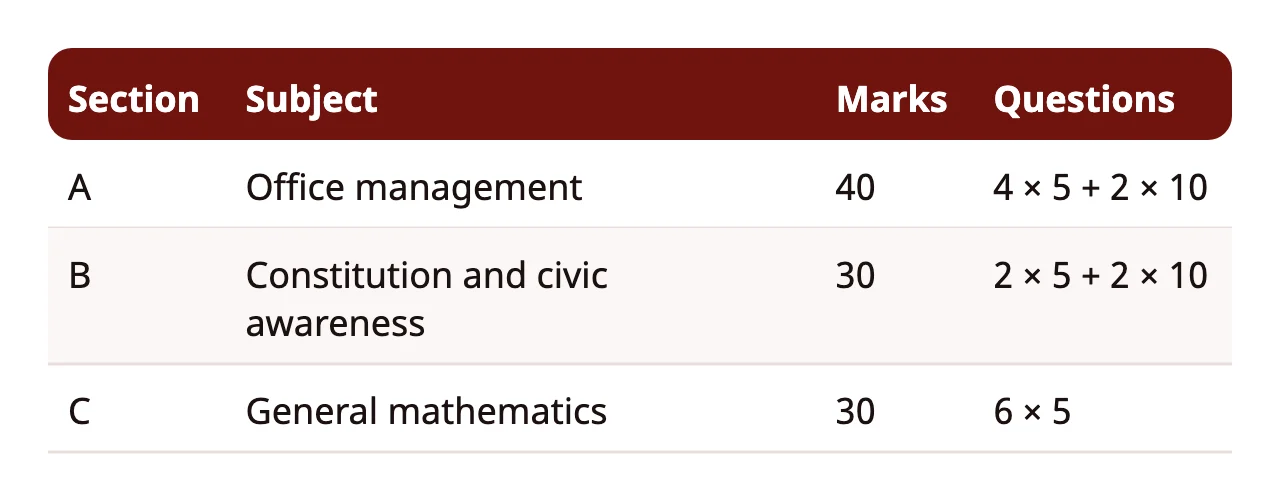
The Kharidar Paper II (Office Management) syllabus from the PSC: Section A office management (40 marks), Section B the constitution and civic awareness (30), Section C general mathematics (30). 100 marks, pass mark 40, 12 five-mark and 4 ten-mark questions in 2 hours 30 minutes.
The Kharidar (खरिदार) second paper, "Office Management", is a written (subjective) paper: 100 marks, pass mark 40, 2 hours 30 minutes. This page lists the units of all three sections of the Kharidar second paper syllabus from the PSC's official PDF.
Kharidar second paper syllabus: Section A, office management (40 marks)
1.1 The office and its staff
- The office: introduction, importance, functions and types.
- The duties and qualities of assistant staff.
- Office resources: introduction and types.
- Communication in the office: importance, types and means.
1.2 Office procedure
- Correspondence: purpose and qualities of a letter; types of letters by use and by priority; registration and dispatch; notices, circulars and orders.
- Writing a note (tippani) and what to keep in mind when preparing one.
- Report writing: introduction, points to keep in mind and types.
1.3 Records management
- Records: introduction, purpose and types; the use of modern technology.
- Filing: introduction, need, methods and ways.
- Indexing: introduction, importance and types.
1.4 and 1.5
- Managing meetings and recording decisions (minuting).
- Methods of public relations and handling service users' complaints.
Section B: the constitution and civic awareness (30 marks)
- The Constitution of Nepal: fundamental rights and duties; directive principles, policies and obligations of the state.
- The introduction and work of these bodies: the Commission for the Investigation of Abuse of Authority, the Office of the Auditor General, the Election Commission, the National Human Rights Commission, the Office of the Prime Minister and Council of Ministers, the Ministry of Federal Affairs and General Administration, and the Federal Parliament Secretariat.
- Civic awareness: character building, human values, civic duties and responsibilities, discipline and positive thinking.
Section C: general mathematics (30 marks)
- Basic operations and the unitary method.
- Fractions, decimals, percentages and ratios.
- Profit, loss and discount.
- Tax, commission and depreciation.
- Simple and compound interest.
- Averages.
- Household arithmetic: electricity, water and telephone bills, currency exchange.
- Mensuration: length, breadth, perimeter, area and volume.
What kind of questions each section asks
Section A has many practical questions: write the format of a letter or a note, explain the registration and dispatch process, or describe the role of modern technology in records management. Answers that show the format score well here.
Section B asks about fundamental rights, the directive principles and the work of constitutional bodies. Write the article numbers and the main provisions correctly; our constitution guide (in Nepali) lists the key articles.
Section C has six 5-mark maths questions, and correct working earns full marks. Practise the formulas for interest, profit and loss, percentages and mensuration every day, and show the formula, the substitution and the final answer clearly in each sum.
Time maths: 150 minutes for 100 marks, which is about 7 minutes for a 5-mark question and about 14 minutes for a 10-mark question. Keep the rest to read your answers again.
How this paper connects to the others
Section B overlaps with unit 3 of the first paper, where the constitution and federalism also appear, so you can prepare both at once. Section A's letters, notes, records and meetings come back in the third paper's public service management and in the daily work of a Kharidar, which is why interview panels also ask about them. The maths of Section C is the only part that is not in another paper, but it is also the part where steady practice turns into full marks most reliably. Start it early and keep a notebook of formulas.
Preparing for this paper
How to write answers, model structures and time management are covered in our guide to the Kharidar second paper (in Nepali). Practise with graded papers in the Kharidar Second Paper course listed below. The whole syllabus is on the Kharidar syllabus page, the marking on the Kharidar exam pattern page, and the companion paper on the third paper syllabus page.
Frequently asked questions
How many questions are in the Kharidar second paper?
Twelve 5-mark and four 10-mark questions, 100 marks in total, in 2 hours 30 minutes. The pass mark is 40.
Can I use a calculator for general maths?
The syllabus bans calculators in the multiple-choice exam. For the written exam, follow the Commission's exam instructions; practise by working out sums by hand.
Do I write every section in one answer book?
No. The syllabus says the answers to each section of a subjective paper go in separate answer books.
Sources
- Kharidar or equivalent syllabus: Stage II (PDF, Nepali), Public Service Commission (2024-07-25)
Courses for this topic
Kharidar Second Paper: Office Management
The 100-mark Kharidar second paper: office management, the constitution and maths, with answer writing.
Kharidar Written Exam Pack: Second and Third Papers
The 200 marks of the written exam: the second and third papers in one pack.

Study in the Dipa App
Buy courses, join Live Classes and practise every day in the app. Payment works inside the app with eSewa.

Author
Dipa Academy editorial team
Dipa Academy's editorial team writes Lok Sewa guides from the Public Service Commission's official syllabus, notices and results, and cites every source.
Read next
Nasu Third Paper: a Different Paper per Service Group
21 November 2026 (मंसिर ५, २०८३)Nasu Second Paper: Contemporary Studies and Public Service
21 November 2026 (मंसिर ५, २०८३)Kharidar Third Paper: the Acts, Accounts and Law to Study
21 November 2026 (मंसिर ५, २०८३)