
Kharidar Third Paper Syllabus: Job Knowledge (पदीय ज्ञान) Units and Acts
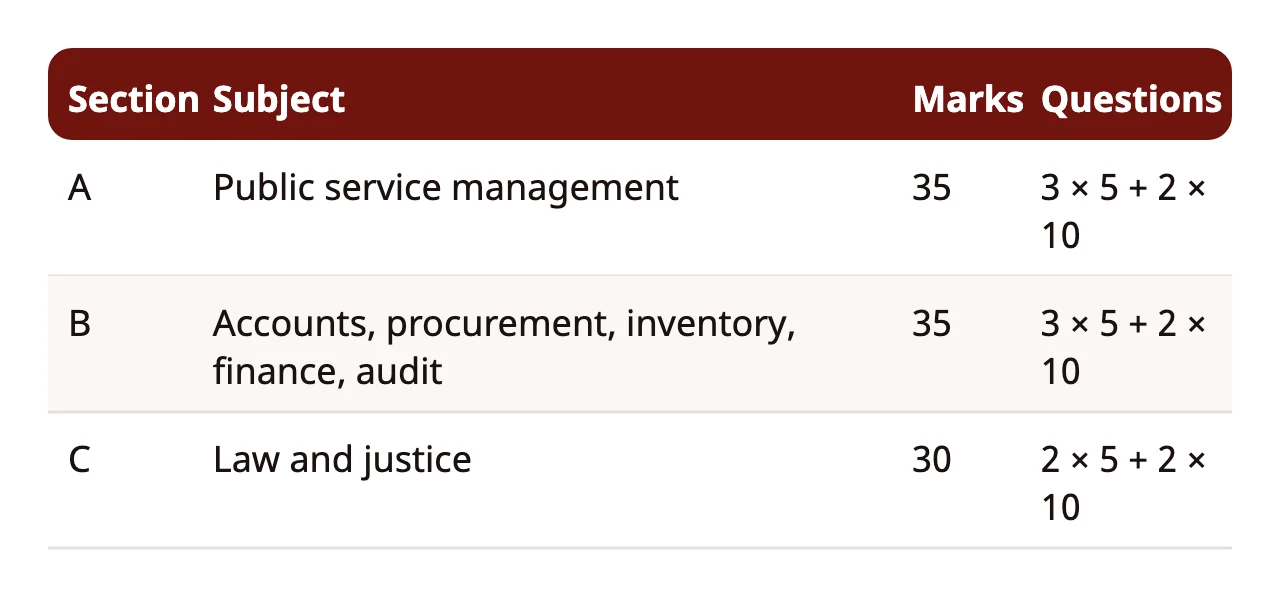
The Kharidar Paper III (Job Knowledge) syllabus from the PSC: Section A public service management (35 marks), Section B accounts, public procurement, inventory, finance and audit (35), Section C law and justice (30). 100 marks, pass mark 40, 8 five-mark and 6 ten-mark questions.
The Kharidar (खरिदार) third paper, "Job knowledge related", is a written paper that most people call Job Knowledge (पदीय ज्ञान): 100 marks, pass mark 40, 2 hours 30 minutes. The Kharidar third paper syllabus names many specific chapters of acts and laws, so the syllabus itself is your reading list. Source: the PSC's official PDF.
Kharidar third paper syllabus: Section A, public service management (35 marks)
The civil service and service delivery
- Provisions of the Civil Service Act and Regulations: formation of the service, methods and process of recruitment; appointment, transfer, promotion, leave, departmental punishment and retirement; the conduct and duties staff must follow.
- Public service delivery: meaning, importance, agencies, methods and channels.
- The citizen's charter: importance and need.
The named acts and chapters
- Good Governance (Management and Operation) Act 2064, chapters 1, 2, 4 and 5.
- Right to Information Act 2064, chapters 1, 2 and 4.
- Prevention of Corruption Act 2059, chapters 1 and 2.
- Federation, Province and Local Level (Coordination and Inter-relation) Act 2077, chapter 2.
- Right to Food and Food Sovereignty Act 2075, chapters 1, 2 and 3.
- Personal event registration and the national identity card.
- A general introduction to e-governance; the importance of information and communication technology and the care to take when using it.
Section B: accounts, public procurement, inventory and audit (35 marks)
Accounts and the budget
- Accounts and the accounting system: introduction, purpose and features.
- Budget estimates and approval; the Line Ministry Budget Information System (LMBIS).
- The chart of accounts, the Treasury Single Account (TSA), the Revenue Management Information System (RMIS), the Computerised Government Accounting System (CGAS) and deposit accounts.
- The journal voucher, bank cash book, budget account, monthly statement, expenditure statement, bank reconciliation and financial statements.
Public procurement and inventory
- Public procurement management: purpose, importance, methods and process.
- Inventory management: the demand form, purchase order, receipt report, inventory register, inventory inspection, purchase and auction; the government property management system.
Audit and tax
- Audit: introduction, purpose and types; irregularities (beruju), settling them and re-audit.
- Value added tax: registration and cancellation, filing returns, tax deduction, taxable and exempt goods.
- The Financial Procedure and Fiscal Accountability Act 2076 (internal control, audit and accountability); chapter 17 of the Income Tax Act 2058 (tax deduction at source); section 8 of the Audit Act 2075.
Section C: law and justice (30 marks)
- The meaning, importance and sources of law; acts, rules, by-laws, formation orders and the Nepal Gazette.
- The levels, structure and jurisdiction of the courts.
- Right to sue, limitation, time limits and dates; the form, registration and endorsement of documents; adjournment of cases.
- First information reports, arrest warrants, seizure records, charge sheets and preliminary hearings.
- Free legal aid.
- The main features of the Civil Code, the Civil Procedure Code, the Criminal Code and the Criminal Procedure Code.
How to make it easier
There are many acts in this paper, but the syllabus tells you which chapters to read. Instead of memorising whole acts, note the main sections, definitions and penalties of the named chapters in a short table.
Section B asks about forms such as the voucher, the cash book and the inventory register. Draw each form by hand once, and you will not forget the format in the exam.
For the legal terms of Section C (right to sue, limitation, adjournment, endorsement), get used to writing a definition and one example. Give 10-mark answers a structure: an introduction, the main points and a conclusion.
Preparing for this paper
Reading only the named chapters, and linking each section to an office example, is explained in our guide to the Kharidar third paper (in Nepali). The full syllabus is on the Kharidar syllabus page, the companion paper on the second paper syllabus page, and courses on Kharidar preparation.
Frequently asked questions
How many questions are in the Kharidar third paper?
Eight 5-mark and six 10-mark questions, 100 marks in total, in 2 hours 30 minutes. The pass mark is 40.
Which chapters of which acts should I study?
The syllabus names them: chapters 1, 2, 4 and 5 of the Good Governance (Management and Operation) Act 2064; chapters 1, 2 and 4 of the Right to Information Act 2064; chapters 1 and 2 of the Prevention of Corruption Act 2059; chapters 1, 2 and 3 of the Right to Food and Food Sovereignty Act 2075, among others.
Why is the third paper called Job Knowledge (पदीय ज्ञान)?
It tests the knowledge a Kharidar uses at work in the office, so it is commonly called job knowledge or padiya gyan.
Sources
- Kharidar or equivalent syllabus: Stage II (PDF, Nepali), Public Service Commission (2024-07-25)
Courses for this topic
Kharidar Third Paper: Job Knowledge (पदीय ज्ञान)
The 100-mark Kharidar Job Knowledge paper: civil service, accounts and procurement, and law, in plain language.
Kharidar Written Exam Pack: Second and Third Papers
The 200 marks of the written exam: the second and third papers in one pack.

Study in the Dipa App
Buy courses, join Live Classes and practise every day in the app. Payment works inside the app with eSewa.

Author
Dipa Academy editorial team
Dipa Academy's editorial team writes Lok Sewa guides from the Public Service Commission's official syllabus, notices and results, and cites every source.
Read next
Nasu Third Paper: a Different Paper per Service Group
21 November 2026 (मंसिर ५, २०८३)Nasu Second Paper: Contemporary Studies and Public Service
21 November 2026 (मंसिर ५, २०८३)Kharidar Third Paper: the Acts, Accounts and Law to Study
21 November 2026 (मंसिर ५, २०८३)