Loksewa Interview Questions and How to Answer Them
The Kharidar and Nayab Subba interview carries 30 marks that count in the final result. The seven question types, an answer format that works, the documents to carry, dress and conduct, and a two-week preparation plan.
Most loksewa interview questions are predictable — and that is exactly why the interview rewards preparation. The oral exam carries 30 marks in both Kharidar and Nayab Subba, those marks are added into the final ranking, and two candidates with identical written scores are routinely separated here.
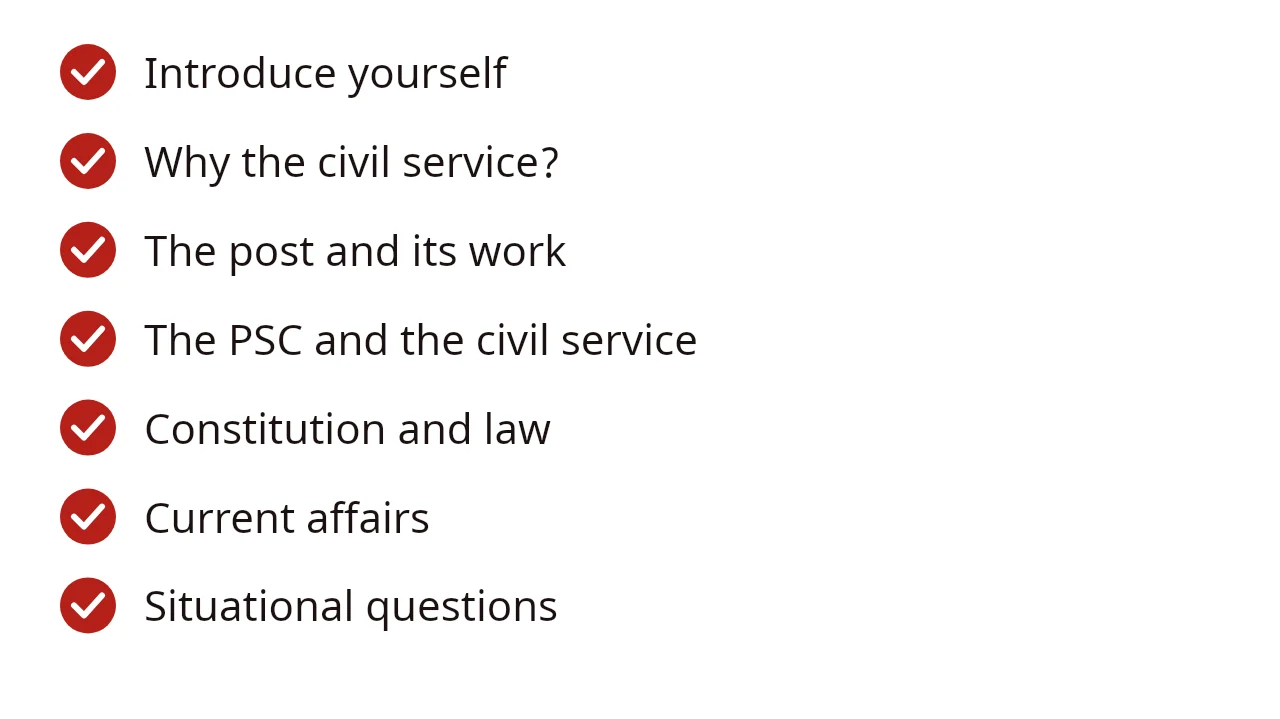
The seven question types
- Introduce yourself. Sixty to ninety seconds: name, district, education, one line on work experience, one line on why this service. Write it, say it aloud, trim it.
- Why the civil service? Connect service delivery and stability honestly; avoid memorised praise. One concrete example of a public service that matters to your district beats three slogans.
- The post and its work. Know what a Kharidar or Nasu actually does: registration, filing, record-keeping, correspondence, front-desk service. Read our Kharidar and Nayab Subba pages the night before.
- The PSC and the civil service. The commission's constitutional place (part 23, articles 242-244), what it recruits, and the basics of the Civil Service Act.
- Constitution and law. The structures from the constitution guide: rights, three tiers, parliament, constitutional bodies.
- Current affairs. The last three months of headline facts — appointments, policies, budget numbers — from the current affairs page.
- Situational questions. "A service seeker is angry at your desk — what do you do?" Answer with a calm sequence: listen, verify, resolve within the rules, escalate when the rules require it.
The answer format
Short, structured, exemplified: direct answer first → one supporting fact or rule → one concrete example → stop. Thirty seconds to a minute for most questions. Rambling is the most common self-inflicted wound; boards reward candidates who finish sentences.
When you do not know
Say so, once, cleanly: "I have not studied that yet; I will learn it." Never guess facts in front of a board — a wrong article number delivered confidently costs more than an honest gap.
Documents, dress and conduct
Carry the originals and attested copies of everything your application claimed: admit card, citizenship, educational certificates, and inclusion documents where relevant — exactly as the advertisement's terms list them. Dress formally and plainly; arrive early; greet the board, sit when invited, keep your phone outside. The first and last thirty seconds — entry and exit — frame everything between.
The two-week plan
- Days 1-3: write and polish the self-introduction; collect post-related facts.
- Days 4-7: constitution and PSC structures; one mock answer per question type daily.
- Days 8-11: current-affairs sweep; situational drills with a friend as the board.
- Days 12-14: two full mock interviews, recorded on your phone; fix pace and posture, prepare the document file.
Common mistakes
Memorised speeches recited at speed; arguing with a board member; criticising named officials or parties; and walking in without knowing the post's daily work. The interview is a conduct test wearing a knowledge test's clothes — calm, honest, structured answers win it.
The final stage also includes the 10-mark computer skill test: prepare it with the typing test and the computer test guide.
Frequently asked questions
How many marks is the Kharidar or Nasu interview worth?
The interview is a 30-mark oral exam in both. The final stage also includes a 10-mark computer skill test, and the final ranking adds the written and final-stage marks together.
Which documents must I bring to the interview?
As the advertisement's terms state: the admit card, citizenship certificate (original and attested copy), educational certificates (originals and copies) and everything claimed in the application, such as inclusion group documents.
What if I am asked something I do not know?
Admit it politely and show willingness to learn. An honest "I do not know this yet" leaves a far better impression than a confidently wrong guess.
Sources
- Kharidar or equivalent syllabus: final stage (PDF, Nepali), Public Service Commission (2024-07-25)
Courses for this topic
Lok Sewa Interview Preparation
The 30-mark final interview: the questions asked, sample answers and mock interviews.
Final Stage Pack: Computer Test + Interview
Passed the written exam? The 40-mark final stage: typing, computer skills and the interview.

Study in the Dipa App
Buy courses, join Live Classes and practise every day in the app. Payment works inside the app with eSewa.

Author
Dipa Academy editorial team
Dipa Academy's editorial team writes Lok Sewa guides from the Public Service Commission's official syllabus, notices and results, and cites every source.
Read next
Nepali Typing Speed for Lok Sewa: How Many Words for How Many Marks
11 November 2026 (कात्तिक २५, २०८३)Loksewa Computer Test: Full Preparation for the 10-Mark, 15-Minute Exam
11 November 2026 (कात्तिक २५, २०८३)Top 10 Loksewa Institutes in Nepal (2026): How to Choose
21 November 2026 (मंसिर ५, २०८३)