
Nasu Second Paper Syllabus: Contemporary Studies and Public Service Management
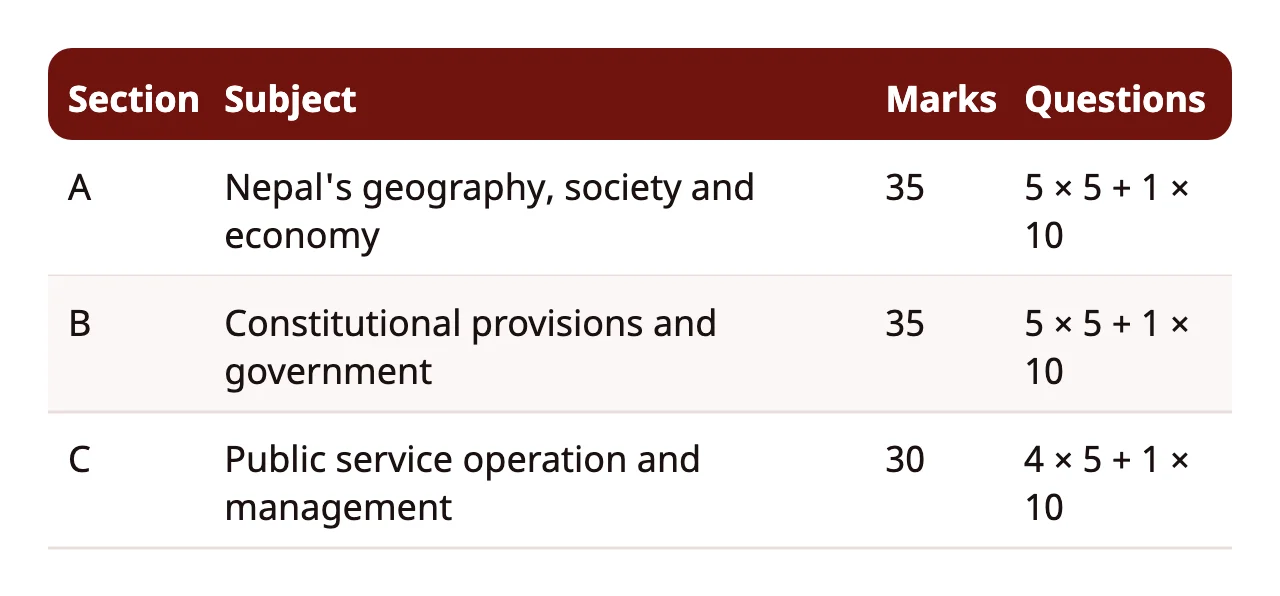
The Nayab Subba Paper II syllabus from the PSC: Section A Nepal's geography, society and economy (35 marks), Section B the constitution and government (35), Section C public service operation and management (30). 14 five-mark and 3 ten-mark questions, pass mark 40.
The Nayab Subba (Nasu, नायब सुब्बा) second paper is "Contemporary Studies and Public Service Management": 100 marks, pass mark 40, 2 hours 30 minutes. Candidates of every service group compete on the same question paper. The units of the Nasu second paper syllabus below come from the PSC's official PDF.
Nasu second paper syllabus: Section A, Nepal's geography, society and economy (35 marks)
- Geographical conditions and landforms; political geography.
- Climate and water resources: status and importance; forest resources, the causes of deforestation and ways to conserve forests.
- The main religions, castes and ethnic groups, languages and cultures.
- Aspects of economic development (agriculture, industry, trade, tourism, employment and infrastructure) and its drivers (the public, private and cooperative sectors).
- Planned development and the current periodic plan.
- Population management, urbanisation and migration; environment, biodiversity, pollution, climate change and sustainable development.
- Burning issues: poverty, unemployment, public health, food security, social security, technology and social media.
- Current events of national and international importance.
Section B: constitutional provisions and government (35 marks)
- The Constitution of Nepal: basic features; fundamental rights and duties; directive principles, policies and obligations; the structure of the state and the division of power; the executive, the legislature and the judiciary.
- Federalism: the federal, provincial and local governments.
- The responsibilities and duties of citizens, civil society and civic education.
- The meaning, importance, sources and precedents of law; the rule of law.
- Inclusion and proportional representation; democracy and human rights.
- The right to information and transparency; e-governance; good governance, integrity and anti-corruption.
Section C: public service operation and management (30 marks)
- Office management: concept and importance; records management; communication in the office; management information systems (MIS).
- Accounts and revenue administration: government accounts and audit; financial procedure; inventory, revenue and deposit records; taxes, customs and excise; the government budget.
- The civil service: formation, recruitment, transfer, promotion, punishment and career development; human resource planning; provincial and local services.
- Public service delivery: meaning, importance, agencies and channels; the role of the service provider and the rights of the service user.
A structure for 10-mark answers
A good 10-mark answer in this paper usually has four parts. Start with a two- or three-line introduction that defines the topic. Then give five to seven main points, each in its own short paragraph or bullet. Add one fact or example from Nepal, such as a provision of the constitution, a figure from the economic survey or a target of the periodic plan, with its source. End with a short conclusion that answers the question directly. Keep 5-mark answers to the introduction and three or four points.
How this paper links to the first paper
Sections A and B share a lot with the first paper's general knowledge: Nepal's geography, society and economy match sub-units 1.3, 1.6 and 1.7, and the constitution and federalism match the governance questions. If you study a topic once for both, write a short MCQ-style note and a longer note with points you can use in a 5-mark answer.
How to study this paper
Each section has one 10-mark question, and that question changes many results. Give a 10-mark answer an introduction, five to seven main points, an example or fact, and a conclusion. Many topics in Sections A and B match the first paper's general knowledge, so studying them together saves time.
Check your sources when you write facts and figures: economic data from the Ministry of Finance's economic survey, and plan targets from the National Planning Commission's documents. Write at least two answers a week and get them checked.
A detailed answer-writing guide is in our Nasu second paper guide (in Nepali), and current affairs are on the current affairs page (in Nepali). The full syllabus is on the Nayab Subba syllabus page, and the marking on the Nayab Subba exam pattern page.
Frequently asked questions
How many questions are in the Nasu second paper?
Fourteen 5-mark questions and three 10-mark questions, one 10-mark question from each section: 100 marks in 2 hours 30 minutes, pass mark 40.
Is the second paper the same for every service group?
Yes. The Nayab Subba first and second papers are the same for every group of the Judicial, Foreign Affairs, Administration, Audit and Parliament services.
Where should I read current affairs for this paper?
Sub-unit 1.12 of Section A covers current events of national and international importance. Read official sources such as government decisions, policies, the budget and the economic survey, along with a regular current affairs summary.
Sources
- Nayab Subba or equivalent syllabus: Stage II (PDF, Nepali), Public Service Commission (2024-07-25)
Courses for this topic
Nayab Subba Second Paper: Contemporary Studies and Public Service Management
The 100-mark Nasu second paper: geography and economy, the constitution and federalism, and public service, with answer…
Nayab Subba Written Exam Pack: Second and Third Papers
The 200 marks of the Nasu written exam: the second and third papers in one pack.

Study in the Dipa App
Buy courses, join Live Classes and practise every day in the app. Payment works inside the app with eSewa.

Author
Dipa Academy editorial team
Dipa Academy's editorial team writes Lok Sewa guides from the Public Service Commission's official syllabus, notices and results, and cites every source.
Read next
Nasu Third Paper: a Different Paper per Service Group
21 November 2026 (मंसिर ५, २०८३)Nasu Second Paper: Contemporary Studies and Public Service
21 November 2026 (मंसिर ५, २०८३)Kharidar Third Paper: the Acts, Accounts and Law to Study
21 November 2026 (मंसिर ५, २०८३)