
Nepali Typing Speed for Lok Sewa: How Many Words for How Many Marks
The Nepali typing speed you need in the Lok Sewa computer test: the PSC's full marks table, how correct words per minute are counted, worked examples, targets and a four-week plan to get faster.
In the final stage of Lok Sewa, typing comes in two parts: Nepali (Devanagari) and English. Each takes 5 minutes and each is worth 2.5 marks. The answer to "what Nepali typing speed do I need?" is clear in the Commission's syllabus itself: 25 correct words per minute or more earns full marks. This article gives the full marks table, how the formula works, what speed to aim for and how to get faster in four weeks.
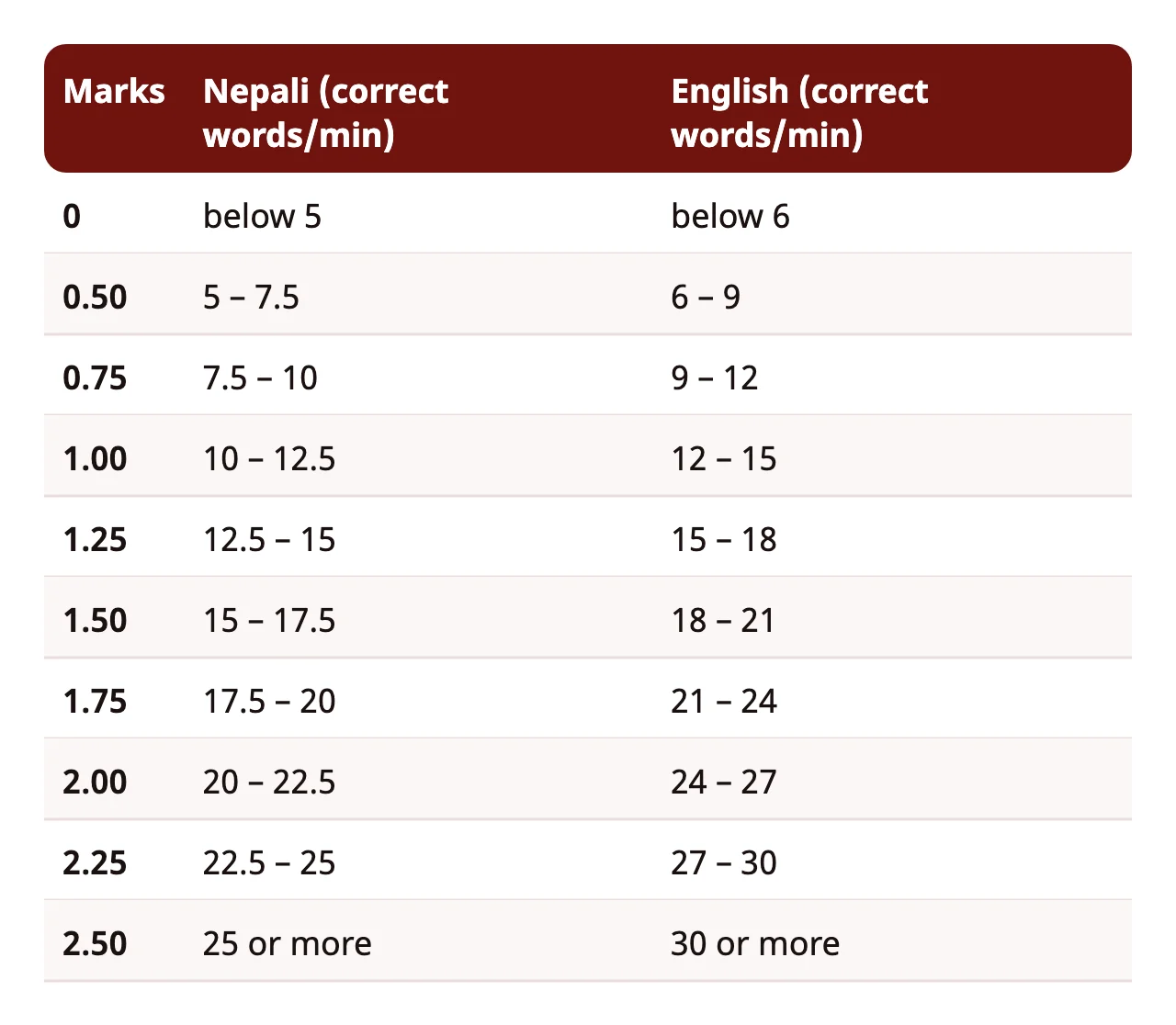
Nepali typing speed and marks: the Commission's table
The Public Service Commission's syllabus says a 150-word passage is given for Devanagari typing and a 200-word passage for English typing. Marks rise in steps of 0.25 up to 2.5. Each band in the table includes its lower limit: for example, exactly 10 correct words per minute in Nepali earns 1.00 mark, but 9.8 earns only 0.75.
The Nayab Subba syllabus has the same table, so one target works for both Kharidar (खरिदार) and Nayab Subba (Nasu, नायब सुब्बा).
The formula: correct words per minute
The Commission's formula:
Correct words per minute = (total words typed − wrong words) ÷ 5
The 5 is the 5 minutes. Your typed text is checked against the given passage. Where the passage has punctuation and you did not type it, that word is not counted.
Example 1: Nepali
You type 90 words in 5 minutes, 8 of them wrong. (90 − 8) ÷ 5 = 16.4 correct words per minute. That falls in the 15 to 17.5 band, so 1.50 marks.
Example 2: English
You type 160 words in 5 minutes, 10 of them wrong. (160 − 10) ÷ 5 = 30 correct words per minute, so the full 2.50 marks.
Example 3: fast but careless
You type 130 Nepali words in 5 minutes, but 30 are wrong. (130 − 30) ÷ 5 = 20 correct words per minute, 2.00 marks. If the same person had typed 115 words with only 5 wrong, (115 − 5) ÷ 5 = 22, the same 2.00 marks with less hurry. Wrong words cut your marks directly, so accuracy comes first.
What speed should you aim for?
In the exam the computer, keyboard and room are new, and speed is usually lower than at home. So set your target a little above the full-marks limit:
- Nepali: 30 correct words per minute in practice, so you stay above 25 in the exam.
- English: 35 correct words per minute in practice, so you stay above 30 in the exam.
To type the whole 150-word Nepali passage in 5 minutes you need 30 words per minute. You do not have to finish the passage for full marks; 25 correct words per minute is about 125 correct words in 5 minutes.
How to measure your speed
Use the Commission's formula when you practise at home too. Our Nepali typing test gives a 5-minute test and shows your correct words per minute and likely marks with the same formula. Write down each day's result in a notebook; in two weeks your progress will be clear.
Get faster in four weeks
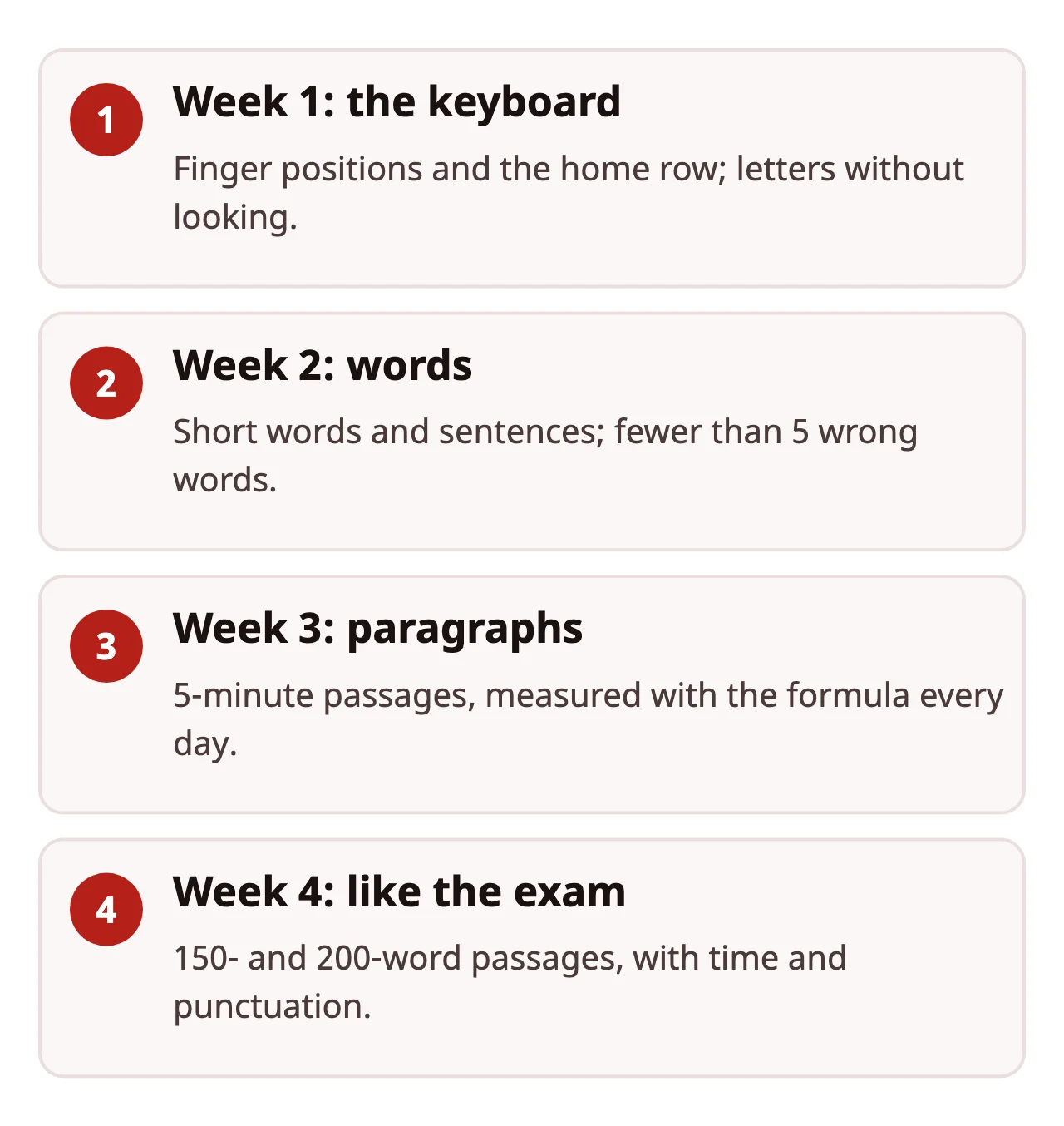
Week 1: learn the keyboard
Start from the right finger positions (the home row). Drop the habit of looking at the keyboard in the first week; your speed falls at first, but from the third week it climbs fast. Twenty to twenty-five minutes a day is enough.
Week 2: words and sentences
Type short words and simple sentences. In Nepali, most mistakes come with half letters, the reph (रेफ), ऋ, ङ, ञ and conjunct letters (क्ष, त्र, ज्ञ); practise them separately.
Week 3: paragraphs against the clock
Type a paragraph from a newspaper or textbook in 5 minutes and measure it with the formula. Build the habit of not leaving out punctuation (। , ?) here.
Week 4: like the exam
Take a 150-word Nepali and a 200-word English passage and type each for 5 minutes as in the exam, then do 5 minutes of Word tasks. Do this full 15-minute practice at least four times a week.
Common mistakes in Nepali typing
- Not matching the keyboard layout: different Nepali layouts and fonts are in use. Confirm which one the exam uses from the Commission's notice or the exam centre, and practise on that layout.
- Leaving out punctuation: if you do not type a full stop, the word at that place is not counted.
- Spending too long on a wrong word: fixing one word three times slows you down; fix it once and move on.
- Practising only on a phone: phone typing and a desktop keyboard are different skills; practise on a keyboard.
- Starting only in the last week: typing speed grows slowly, so practise a few days a week alongside your written-exam preparation.
Why English typing feels easier
English has no conjunct letters or vowel signs, so most people type it faster than Nepali, and the Commission's English bands are set a little higher too (30 for full marks). In English, most mistakes are with capital letters and spelling; pay attention to pressing Shift and to the spelling of common words.
On exam day
Adjust the keyboard, mouse and chair before you start. Glance at the passage once, but do not spend time reading all of it. Keep a finger on the passage to track the line so you do not skip one. Listen carefully to whether you must save before time runs out.
The Dipa App's Computer Skill Test and Typing course has Nepali and English typing practice and videos of the Word tasks, and you can practise on your laptop with the desktop app; see the Windows and Mac desktop app.
A 20-minute daily typing routine
Short regular practice raises typing speed far more than long sessions. Build a routine like this:
| Time | Task |
|---|---|
| 3 minutes | Warm-up on the home row and difficult letters |
| 5 minutes | A Nepali paragraph, timed |
| 5 minutes | An English paragraph, timed |
| 4 minutes | Retype the words you got wrong |
| 3 minutes | Work out your speed with the formula and write it down |
One day a week, replace it with a full 15-minute sample exam (Nepali, English and Word). At the start of preparation, 10 correct words per minute in Nepali and 15 in English are normal; with regular practice your speed rises week by week.
Typing and the full marks of the exam
The 5 typing marks, the 5 Word marks and the 30 interview marks make the 40-mark final stage, which is added to the main exam to make the final result. The full formats are on the Kharidar exam pattern and Nayab Subba exam pattern pages.
How to record your progress
For each practice, write four things in your notebook: the date, the language, the total words typed and the wrong words. Work out your correct words per minute from them. At the end of the week look at your average speed, not your best, because the exam is most likely to show your average. If you keep getting more than 8 to 10 wrong words, stop pushing speed and focus only on accuracy for two or three days.
Conclusion
The 5 typing marks are added to the final result, and in a close competition they can make the difference. Aim for 25 correct words per minute in Nepali and 30 in English, accuracy first and speed second, and measure every practice with the Commission's formula; that puts full marks within reach. The full format of the test is in our Loksewa computer test guide.
Frequently asked questions
What Nepali typing speed gets full marks in Lok Sewa?
25 or more correct words per minute in Devanagari typing earns the full 2.5 marks. Below 5 earns 0.
What English typing speed gets full marks?
30 or more correct words per minute in English typing earns the full 2.5 marks. Below 6 earns 0.
How are correct words per minute calculated?
(Total words typed − wrong words) ÷ 5. A word typed without the punctuation shown in the passage is not counted.
Sources
- Kharidar or equivalent syllabus: marks table of the computer skill test (PDF, Nepali), Public Service Commission (2024-07-25)
- Nayab Subba or equivalent syllabus: computer skill test (PDF, Nepali), Public Service Commission (2024-07-25)
Courses for this topic
Lok Sewa Computer Skill Test and Typing
The 10-mark final-stage computer test: Windows, MS Word, Nepali and English typing.
Final Stage Pack: Computer Test + Interview
Passed the written exam? The 40-mark final stage: typing, computer skills and the interview.

Study in the Dipa App
Buy courses, join Live Classes and practise every day in the app. Payment works inside the app with eSewa.

Author
Dipa Academy editorial team
Dipa Academy's editorial team writes Lok Sewa guides from the Public Service Commission's official syllabus, notices and results, and cites every source.
Read next
Loksewa Interview Questions and How to Answer Them
21 November 2026 (मंसिर ५, २०८३)Loksewa Computer Test: Full Preparation for the 10-Mark, 15-Minute Exam
11 November 2026 (कात्तिक २५, २०८३)Top 10 Loksewa Institutes in Nepal (2026): How to Choose
21 November 2026 (मंसिर ५, २०८३)