
Nasu Third Paper Syllabus: General Administration and Parliament Service
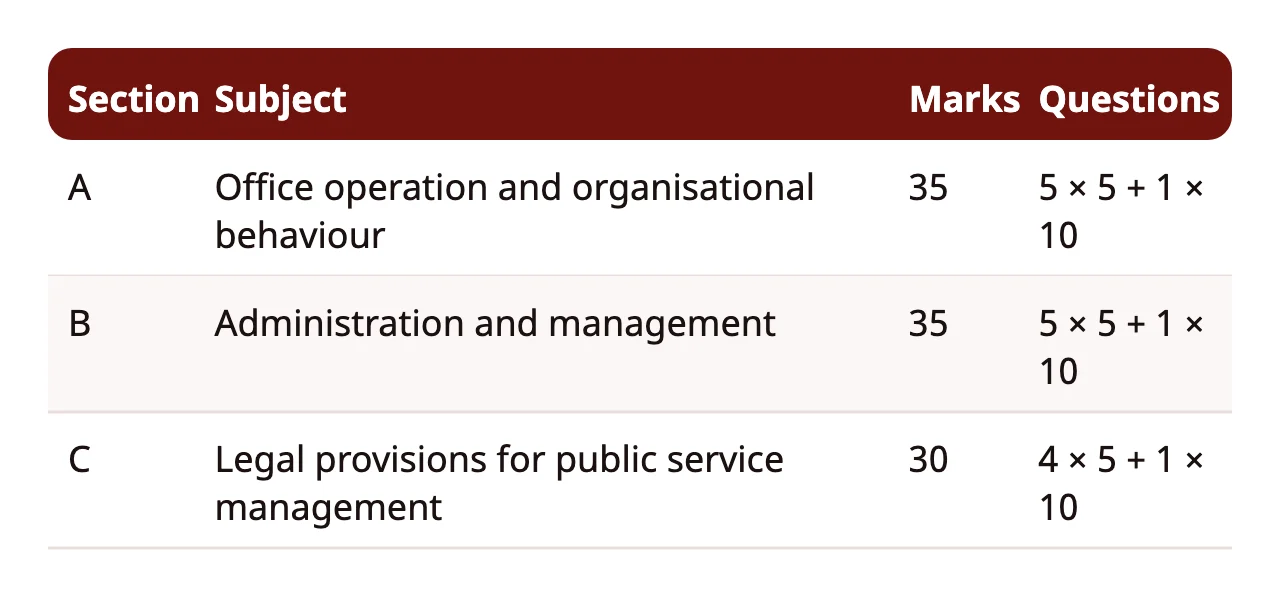
The Nayab Subba Paper III syllabus for the Nepal Administration Service (General Administration group) and the Parliament Service: Section A office operation and organisational behaviour (35 marks), Section B administration and management (35), Section C legal provisions for public service management (30).
The Nayab Subba (Nasu, नायब सुब्बा) third paper depends on your service group. This page covers the Nasu third paper syllabus taken by the most candidates: the Nepal Administration Service, General Administration group, and the Nepal Parliament Service. It is 100 marks, pass mark 40, 2 hours 30 minutes. Source: the PSC's official PDF.
Nasu third paper syllabus: Section A, office operation and organisational behaviour (35 marks)
- Registration, dispatch, filing and correspondence; writing notes, proposals and reports.
- Public relations and handling service users' complaints.
- Managing meetings and writing decisions (minutes); organising seminars, workshops and conferences.
- Records management; monthly and annual progress management.
- An introduction to inventory records; the demand form, purchase order, receipt report and inventory register.
- Job descriptions and delegation of authority; office inspection and monitoring; settling administrative work.
- Organisational norms and the status system.
Section B: administration and management (35 marks)
- Public administration: introduction, purpose and functions; public administration and development administration.
- Civil servants: appointment, deputation, transfer, promotion, leave, conduct, retirement and departmental punishment.
- Organisation: introduction, purpose, forms and bases.
- The introduction and work of the Commission for the Investigation of Abuse of Authority, the Office of the Auditor General, the Office of the Prime Minister and Council of Ministers, the Ministry of Federal Affairs and General Administration, and the Federal Parliament Secretariat.
- Management: introduction and functions; leadership, decision making, motivation and morale; control and coordination; group dynamics; organisational change and development; time management.
Section C: legal provisions for public service management (30 marks)
- The Government of Nepal (Allocation of Business) Rules.
- Legal provisions on running local government; the Local Administration Act 2028.
- The Good Governance (Management and Operation) Act 2064.
- Legal provisions on public procurement, the right to information, and financial procedure and fiscal accountability.
- Legal provisions on disaster risk reduction and management.
- The concept, practice and law of preventing money laundering.
- The Federal Parliament Secretariat Act 2064 and the Federal Parliament Secretariat Staff Administration Rules 2065.
What kind of questions to expect
Expect practical tasks in Section A, such as writing a note (tippani), a progress report or the minutes of a meeting in the right format. Section B asks for concepts with examples, such as the functions of management, the bases of organisation, or the work of a constitutional body. Section C asks what a named act or rule provides: who does what, the time limits and the penalties. Each section has one 10-mark question, so practise at least one long answer from every section.
Other service groups
The PSC sets a separate third paper for each service group, for example Accounts, Revenue, Judicial and Foreign Affairs. Their sections and laws are different from the ones above, and the Foreign Affairs paper on English language and diplomatic subjects is answered in English only. The first and second papers stay the same, so if you change group later, you only change your third-paper preparation. Check the group, service and paper named in the advertisement before you choose.
How to study this paper
Section A is practical: practise by writing model formats of notes, reports and minutes. In Section B, linking a theory to an example from Nepal makes an answer stronger; in a question on leadership, for instance, write about the role of the head of an office. Put the main sections, bodies and penalties of the Section C acts in a short table.
Because the third paper differs by service group, confirm your service, group and paper in the advertisement before you prepare. Detailed preparation advice is in our Nasu third paper guide (in Nepali). The full syllabus is on the Nayab Subba syllabus page, the companion paper on the second paper syllabus page, and the courses on Nayab Subba preparation.
Frequently asked questions
Is the Nasu third paper the same for everyone?
No. The third paper differs by service group. This page covers the Nepal Administration Service, General Administration group, and the Nepal Parliament Service. The Accounts, Revenue, Judicial and Foreign Affairs groups have their own papers.
Which acts are in the third paper?
Section C covers the Allocation of Business Rules, the laws on running local government, the Local Administration Act 2028, the Good Governance Act 2064, and the laws on public procurement, the right to information, financial procedure, disaster risk reduction, anti-money laundering and the Federal Parliament Secretariat.
Which third paper does Dipa Academy teach?
Dipa Academy has a course for the Nayab Subba third paper on General Administration and the Parliament Service.
Sources
- Nayab Subba or equivalent syllabus: Stage II (PDF, Nepali), Public Service Commission (2024-07-25)
Courses for this topic
Nayab Subba Third Paper: General Administration and Parliament Service
The 100-mark Nasu General Administration paper: office operation, management and administrative law.
Nayab Subba Written Exam Pack: Second and Third Papers
The 200 marks of the Nasu written exam: the second and third papers in one pack.

Study in the Dipa App
Buy courses, join Live Classes and practise every day in the app. Payment works inside the app with eSewa.

Author
Dipa Academy editorial team
Dipa Academy's editorial team writes Lok Sewa guides from the Public Service Commission's official syllabus, notices and results, and cites every source.
Read next
Nasu Third Paper: a Different Paper per Service Group
21 November 2026 (मंसिर ५, २०८३)Nasu Second Paper: Contemporary Studies and Public Service
21 November 2026 (मंसिर ५, २०८३)Kharidar Third Paper: the Acts, Accounts and Law to Study
21 November 2026 (मंसिर ५, २०८३)